


Mushroom Coffee vs. Mushroom Drinks: Which Delivers Better Results?

Mushroom coffee turned a niche supplement category into a 200,000-search-per-month phenomenon. It also quietly trained an entire generation of buyers to confuse "mushroom" with "low-caffeine coffee."
That's the trick of the format. The mushroom is in the headline. The coffee is doing most of the work.
If you bought your first bag of mushroom coffee because you wanted Lion's Mane, Cordyceps, or Reishi — and you're still drinking it because you like the caffeine ritual — you're not alone, and you're not wrong. But you also haven't really tried what mushrooms can do without coffee in the way. This is the head-to-head we wish existed when we started formulating Happie's Fungi Fusion line: mushroom coffee vs. mushroom drinks, judged on the four things that actually decide results — caffeine, dose, extraction, and bioavailability.
Why Mushroom Coffee Took Off
Four Sigmatic launched the modern mushroom coffee category in 2012 by stuffing instant coffee with Lion's Mane and Chaga. MUD\WTR turned it into a wellness lifestyle. RYZE rode the trend straight onto Target shelves nationwide in January 2026 — the first mushroom coffee brand to make it to mass retail.
The pitch worked because it solved a real problem: people felt jittery on regular coffee and curious about adaptogens, but they didn't want to learn a new ritual. Pour, sip, done. Mushroom coffee meets people exactly where their mornings already are.
That's the strength of the format. Familiarity. Habit. Zero behavior change.
But familiarity is also the trap. If a category's main selling point is "tastes like coffee," the mushroom is along for the ride.
Pete's perspective. When we started Happie, half the people I talked to said "I love mushroom coffee" — and when I asked which mushrooms, almost none could name them. They liked the ritual. They trusted the marketing. They had no idea what dose they were taking. That gap is the whole reason we built Fungi Fusion as a separate format.
The Three Hidden Limits of Mushroom Coffee
Once you look past the packaging, mushroom coffee has three structural problems that no amount of brand marketing can fix.
1. Caffeine is doing most of the work
Most mushroom coffees contain 35–90mg of caffeine per serving. MUD\WTR runs around 35mg, Everyday Dose around 45mg, RYZE around 48mg, and traditional mushroom coffee blends from Four Sigmatic come in at 50–90mg depending on the SKU. That's lower than a regular cup, but it's not "caffeine-free," and the caffeine is what's most reliably producing the alertness people credit to the mushrooms.
If you stop drinking mushroom coffee for three days and notice fatigue, headaches, or brain fog, that's caffeine withdrawal — not a Lion's Mane deficit.
2. The mushroom dose is rarely transparent
Most mushroom coffees publish a "proprietary blend" total: "2,500mg of mushroom blend including Lion's Mane, Chaga, Reishi, and Cordyceps." That number is the entire blend. The actual amount of each mushroom is unspecified, and the published clinical research on Lion's Mane uses 750–3,000mg per day of the single mushroom — not a multi-mushroom stack.
If a 2,500mg blend is split across four mushrooms with cacao and chai filler, your real Lion's Mane dose could be anywhere from 200mg to 800mg. You won't know. The label doesn't say.
3. Extraction method is usually the cheap one
Functional mushrooms have two main bioactive compound families: beta-glucans (water-soluble, hot-water extraction) and triterpenes (fat-soluble, alcohol extraction). The clinical-grade approach is dual extraction — both processes, then the extracts are combined. It's slower, more expensive, and produces a more complete bioavailable compound profile.
Many mushroom coffees use single hot-water extraction or, worse, raw mycelium grown on grain — which inflates the beta-glucan number but includes a lot of grain starch in the final powder. The Journal of Ethnopharmacology has published repeatedly on why dual extraction matters for the triterpenes that drive Reishi and Lion's Mane benefits.
Cheap extraction looks the same on a label as clinical extraction. The difference shows up in your body.
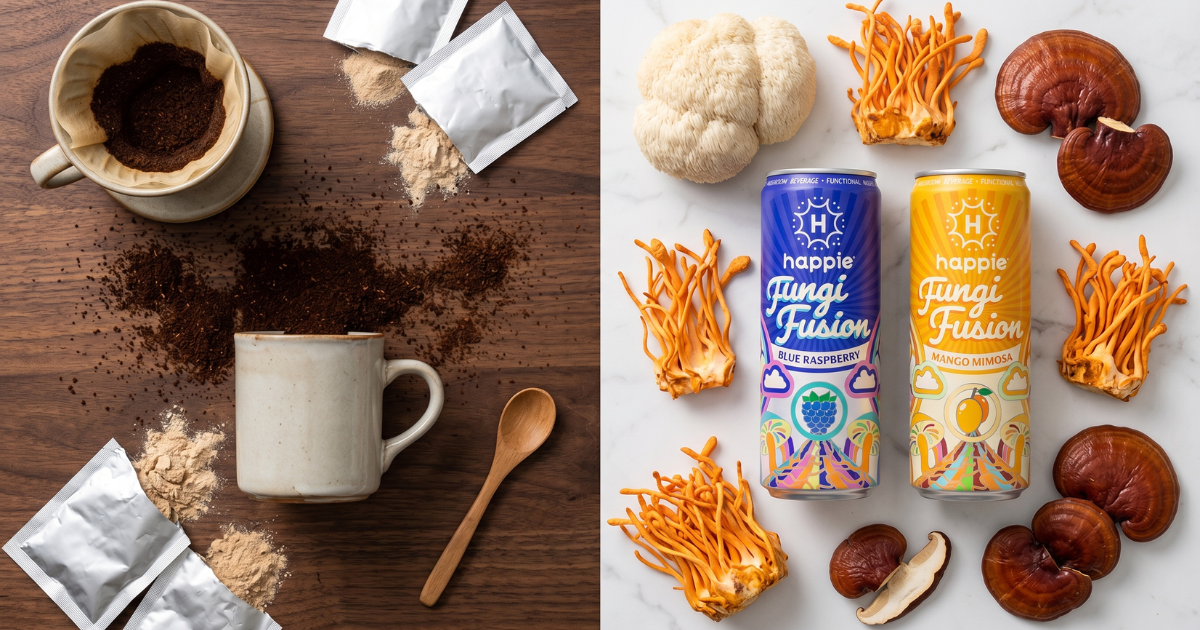
How Mushroom Drinks Solve the Format Problem
A ready-to-drink mushroom beverage — what the industry now calls a "functional mushroom drink" or "RTD mushroom drink" — solves all three of those limits by changing one thing: it removes the coffee.
Once coffee is no longer the carrier, three things become possible:
- The mushroom is the entire product. No caffeine doing the heavy lifting. No flavor compromise to make hot grounds palatable. The dose can be precise because it doesn't need to share a label with chai or cacao.
- The format unlocks new occasions. Coffee is a morning ritual. A can is portable, refrigerator-stocked, and works at 2pm, 7pm, or post-workout — all the times when caffeine would have ruined the day.
- Extraction can be done right. Liquid formats let formulators dose pre-extracted, pre-quantified mushroom inputs at clinical levels because the cost math is different — you're paying for the mushroom, not for filler.
The result is a category that is genuinely about mushrooms, sold to people who want functional benefits without committing to another caffeinated beverage on top of the coffee they're already drinking.
Pete's perspective. The single most common DTC pattern we see is "I still drink my morning coffee, and I drink Fungi Fusion at 2pm or after the gym." Customers aren't choosing between coffee and mushrooms — they're choosing between adding more caffeine and adding mushrooms. The RTD format is what makes that addition work.
Head-to-Head: Mushroom Coffee vs. Mushroom Drinks
Here's how the two formats compare on the dimensions that actually decide results:
| Dimension | Mushroom Coffee | Mushroom Drinks (RTD) |
|---|---|---|
| Caffeine | 35–90mg per serving | 0mg (in caffeine-free brands like Fungi Fusion) |
| Mushroom dose disclosure | Often a proprietary blend; per-mushroom dose unclear | Per-mushroom mg listed on the can in clinical-dose brands |
| Extraction quality | Frequently single-extraction or grown-on-grain mycelium | Pre-extracted, often dual-extracted in premium brands |
| Format flexibility | Morning ritual only (caffeine constrains use) | Any time of day; portable; cold-format |
| Onset & ritual | Slow brew or hot mix; 5–15 minute prep | Crack a can; instant |
| Best for | Replacing or reducing your existing coffee habit | Adding clinical-dose functional benefits without more caffeine |
| Calories & sugar | Coffee is near-zero, but most lattes add cacao, MCT, sweeteners (50–150 cal) | Varies — Fungi Fusion is 40 cal per can with no added sugar |
| Habit cost | Have to brew or stir | None — open and drink |
| Where you can drink it | Home, office, café | Anywhere — cars, gym, restaurants, late afternoon |
The honest takeaway: mushroom coffee and mushroom drinks aren't really competing for the same job. Mushroom coffee competes with regular coffee. Mushroom drinks compete with everything else in your fridge — and with the idea that you need caffeine to feel sharp.
The Caffeine Question
This is the single biggest decision point, and most articles dance around it.
Caffeine is a real, well-studied stimulant that improves reaction time, focus, and alertness. It also has well-known costs: tolerance buildup, sleep disruption, anxiety amplification at higher doses, dependency that produces withdrawal symptoms within 12–24 hours, and a half-life of 5–6 hours that makes any caffeine after 2pm a sleep risk for many people.
Lion's Mane is a different mechanism entirely. It's not a stimulant. It's a nerve growth factor (NGF) modulator with cognitive support properties documented in clinical trials at 1,000–3,000mg per day for 12–16 weeks (Mori et al., 2009 is the best-known reference). The benefits are slower-building, durable, and stack with sleep rather than degrading it.
The mistake mushroom coffee buyers make is assuming the two work the same way. They don't.
If you're chasing the sensation of focus right now, caffeine wins on speed. If you're trying to actually build cognitive resilience over weeks and months — the thing the research on Lion's Mane is actually about — the caffeine in mushroom coffee can mask whether the mushroom is doing anything. You can't feel a 30-day Lion's Mane response when caffeine is producing a 30-minute alertness response on top of it.
Pete's perspective. I formulated Fungi Fusion caffeine-free on purpose, even though the easier sales path was clearly to follow Odyssey, which packs 222mg of caffeine into its mushroom RTD. The thesis was simple: if our customers feel something at 3pm without caffeine, they know it's the mushrooms. If they feel something at 9am with 50mg of caffeine, they don't.
Dosage & Extraction: What the Research Actually Says
The clinical research on functional mushrooms is older than most people realize and converges on three principles:
- Per-mushroom dose matters more than blend totals. The published trials on Lion's Mane that produced cognitive endpoints used 750–3,000mg per day of Lion's Mane alone (Mori et al. 2009 used 1,000mg/day for 16 weeks). A "2,500mg blend" containing six mushrooms is not the same as 1,000mg of Lion's Mane.
- Dual extraction outperforms single extraction. Beta-glucans (immune and gut benefits, water-extracted) and triterpenes (Reishi's relaxation profile, alcohol-extracted) require different solvents. The Journal of Ethnopharmacology and a growing number of supplement industry analyses show that dual-extracted mushroom inputs produce a more complete bioactive profile per gram.
- Whole-fruiting-body beats mycelium-on-grain. Mycelium grown on grain substrates (the cheaper supply chain) ends up testing high for beta-glucans because the grain itself contributes to the number. Whole-fruiting-body extracts contain the actual mushroom compounds the research is built around.
The NIH Office of Dietary Supplements is conservative on functional mushroom claims, but acknowledges the mechanism is real, the safety profile is strong, and the dose-response question is the right one to ask.
The practical translation: when you're comparing a mushroom coffee at "2,500mg blend" against a mushroom drink at "900mg Lion's Mane (whole fruiting body, dual-extracted)," the dose-on-the-can is the answer to which one is actually clinical.
Bioavailability: Why Liquid Format Wins When Done Right
Bioavailability is the percentage of a compound your body absorbs and uses. For mushroom compounds, three factors dominate:
- Extraction quality (covered above): pre-extracted, pre-quantified inputs absorb better than raw powder.
- Carrier liquid: water with electrolytes and trace minerals can improve absorption of water-soluble beta-glucans. We use ocean-derived minerals in Fungi Fusion for this reason.
- Empty stomach vs. with food: mushrooms generally absorb better on a relatively empty stomach. RTD format makes this easy — you can sip between meals. Mushroom coffee is usually consumed with breakfast, which can blunt the absorption window.
This is the case where format isn't a marketing flourish. It directly affects how much of the compound makes it into your system.
A note on what bioavailability isn't: it isn't onset. You're not going to feel Lion's Mane the way you feel caffeine. The cognitive endpoints in the research show up at 4–12 weeks. Bioavailability matters for the long arc, not the next 30 minutes.
Happie Fungi Fusion: What We Built and Why
Fungi Fusion is the answer to the question "what does a mushroom RTD look like when it's not trying to also be coffee?"
The dose:
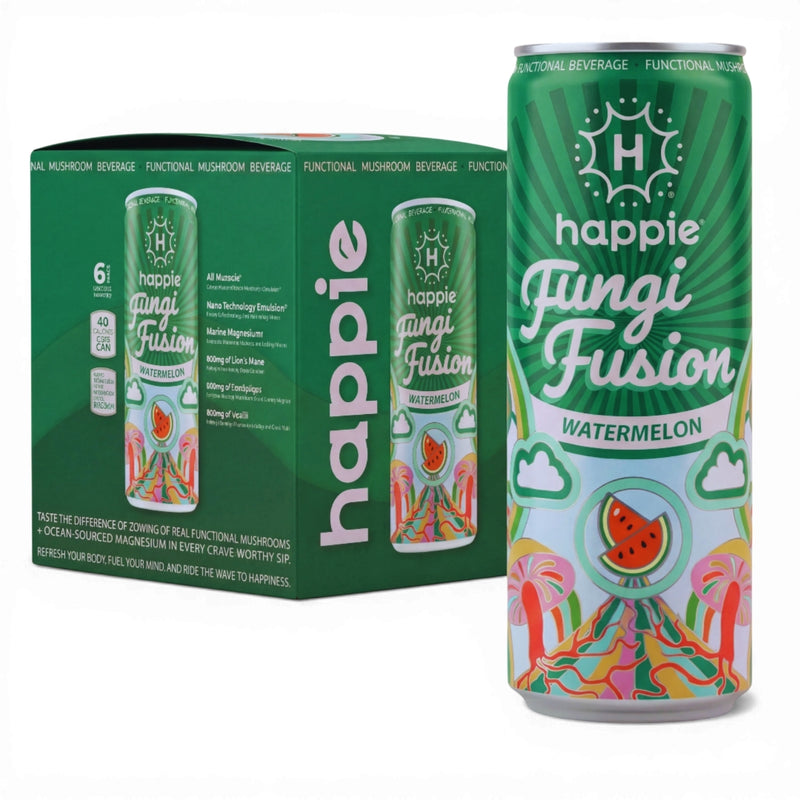
- Lion's Mane (Watermelon): 900mg per can — the highest published Lion's Mane dose in any RTD on the market in 2026
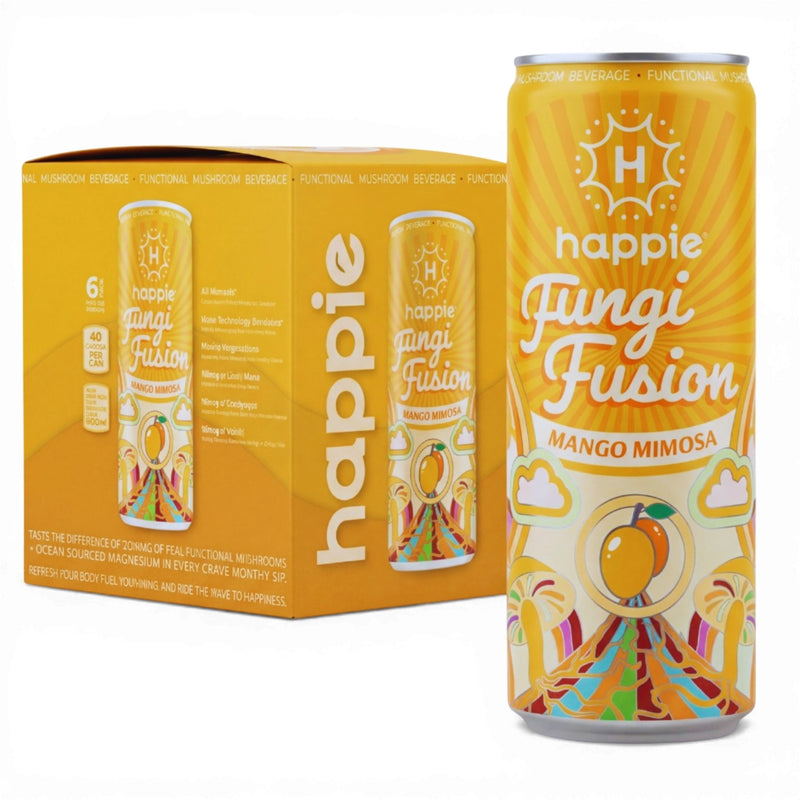
- Cordyceps (Mango): 700mg per can
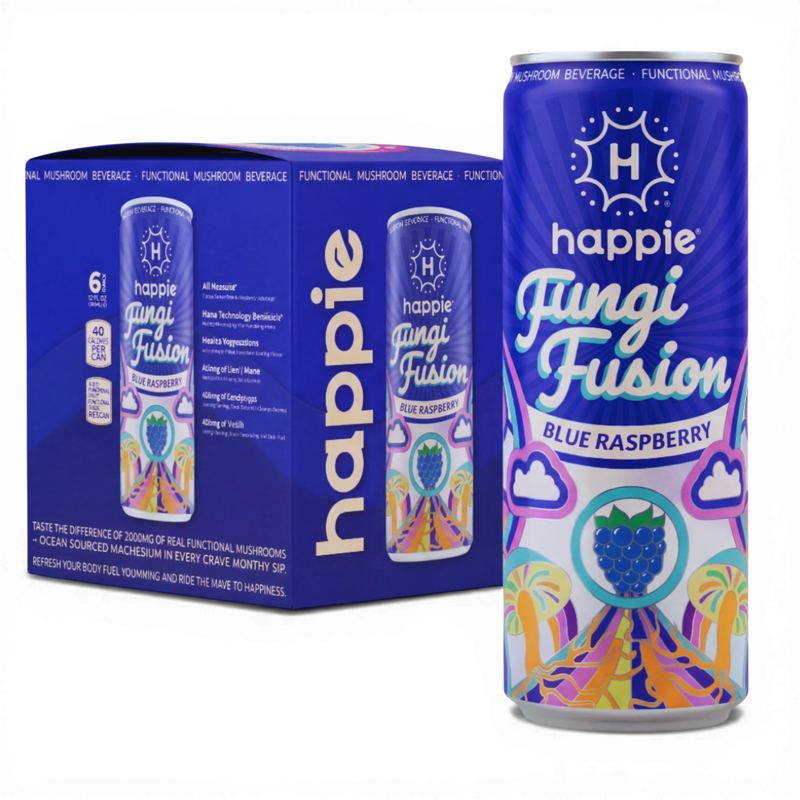
- Reishi (Blue Raspberry): 400mg per can
The build:
- Caffeine-free. Zero. Not "low caffeine" — none.
- Whole-fruiting-body, dual-extracted mushroom inputs. Not mycelium-on-grain.
- Ocean-derived minerals for hydration and absorption support.
- 40 calories per can with no added sugar.
- Three single-mushroom SKUs rather than a blend, so you can match the mushroom to the moment — Lion's Mane for focus, Cordyceps for energy and immunity, Reishi for evening calm.
The single-mushroom-per-can choice is deliberate. Blends are great if you don't know what you want. Single inputs are better if you do — because the dose is honest, the function is targeted, and you can stack them yourself across the day instead of relying on whatever ratio the brand chose for you.
Pete's perspective. The closest comparable on shelf is Odyssey, which is a strong RTD but packs 222mg of caffeine plus a 1,500mg Lion's Mane and 1,250mg Cordyceps blend in the same can. That's a different category — it's a high-caffeine functional energy drink. We built Fungi Fusion specifically for the moments where caffeine is the problem, not the solution: afternoon focus, post-gym recovery, evening wind-down.
Who Should Drink What: A Decision Framework
A simple way to choose:
Choose mushroom coffee if:
- You currently drink 2+ cups of regular coffee per day and want to reduce caffeine without quitting the ritual
- The morning routine is non-negotiable
- You're satisfied with a blended dose and don't need clinical-level transparency
- The hot, bitter, frothy coffee experience is what you actually want
Choose mushroom drinks (RTD) if:
- You already drink coffee and don't want more caffeine on top of it
- You want the mushroom benefit without the stimulant — especially after 12pm
- You want the dose printed clearly per mushroom on the can
- You want a portable, fridge-ready format that works at the gym, the office, or before bed
- You're tracking results over weeks (better to do this caffeine-free)
Choose both if:
- You like coffee in the morning and want a clinical-dose functional add-on later in the day. This is the most common Happie customer pattern. We're not asking anyone to quit coffee — we're asking them to stop pretending coffee is doing the mushroom's job.
Frequently Asked Questions
Is mushroom coffee actually healthier than regular coffee?
Slightly. The mushroom additions are real, and the average mushroom coffee has 30–50% less caffeine than regular drip. But it's still primarily coffee, and most of the alertness you feel is the caffeine. If your goal is mushrooms, a caffeine-free RTD delivers more mushroom per serving and removes the caffeine variable from your results.
Will mushroom drinks give me energy like coffee does?
Not in the same way. Lion's Mane and Reishi are not stimulants — they don't produce a 30-minute alertness spike. Cordyceps is the closest functional mushroom to a "natural energy" effect, and it works through oxygen utilization and ATP support rather than caffeine. The honest answer: if you want a 30-minute jolt, drink coffee. If you want sustained, build-over-weeks cognitive and energy support, drink mushroom RTDs.
How long until I notice mushroom drink effects?
Some users report immediate hydration and mood lift from the first can, especially with Reishi in the evening. The cognitive effects of Lion's Mane in the published research show up at 4–12 weeks of consistent daily use. We recommend tracking for at least 30 days before judging whether the format works for you.
What is dual extraction and does it actually matter?
Dual extraction is the process of extracting mushroom compounds with both hot water (for beta-glucans) and alcohol (for triterpenes), then combining the extracts. It produces a more complete bioactive profile than single extraction. It matters most for Reishi and Lion's Mane, where many of the active compounds are alcohol-soluble triterpenes that hot-water-only extraction misses.
Is Fungi Fusion safe to drink every day?
Yes. Functional mushrooms have a strong safety profile in the published literature. Most clinical trials run 12–16 weeks of daily use without significant side effects. As with any supplement, check with your doctor if you're pregnant, nursing, or on medications.
Can I mix mushroom drinks with mushroom coffee?
You can, but you don't need to. The mushrooms in mushroom coffee and the mushrooms in Fungi Fusion are the same compounds. What matters is total daily dose. If you're drinking a quality mushroom coffee in the morning and a Fungi Fusion in the afternoon, you're stacking — which is fine, just be aware of the cumulative dose.
Why is Fungi Fusion caffeine-free when most mushroom RTDs have caffeine?
Because caffeine masks the mushroom. We wanted customers to be able to tell whether the mushroom was working, and the only way to do that cleanly is to remove the stimulant from the equation. It's also why our customers can drink Fungi Fusion at 4pm without ruining their sleep — a use case caffeinated mushroom RTDs simply can't serve.
Where the Category Is Going Next
The 2026 mushroom beverage shelf is bifurcating. Mushroom coffee — Four Sigmatic, MUD\WTR, RYZE, Everyday Dose — is going mainstream. RYZE in Target is the proof point. The category is no longer niche; it's just a slightly-healthier coffee brand category.
Mushroom drinks are doing something different. The RTD lane is splitting between caffeinated functional energy drinks (Odyssey, several new entrants) and caffeine-free, clinical-dose functional beverages (Happie Fungi Fusion is currently the only brand fully committed to this position).
That second lane — caffeine-free, dose-transparent, single-mushroom RTDs — is the one we're building. It exists for everyone who tried mushroom coffee, liked the idea, and realized somewhere around month three that the energy was just the caffeine. It's the format for adults who want what mushrooms actually do, on the schedule they actually live.
If that's you, Fungi Fusion is built for you. If you're still figuring out which format fits your routine, our full breakdown of Lion's Mane drinks vs. powders vs. capsules is the next read.
Either way: pick the format that lets the mushroom do the work. The category is finally honest enough to deliver on it.
About the author. Pete Olander is the founder and CEO of Happie Beverages, maker of Fungi Fusion functional mushroom drinks and Happie Delta-9 THC seltzers. He writes about formulation decisions, distribution, and the functional beverage category from the inside.
Share:
Shop the Lineup
Pair what you just read with the drinks made for it.



-

The THC Drink Ban Has Two Deadlines Now, Not One
The hemp THC deadline moved to December 11 — but one class of product still loses legal status November 12. Which date applies to what, from a founder inside it. -

Mushroom Drinks Instead of Alcohol: The Sober-Curious Swap That Actually Sticks
Swapping alcohol for mushroom drinks? Here's how functional mushroom drinks work as an alcohol alternative — the science, the ritual, and how to choose.
-

Fruiting Body vs Mycelium: The Mushroom Supplement Difference That Actually Matters
Fruiting body vs mycelium: the mushroom supplement difference that decides whether you are drinking real potency or the grain it was grown on.


