


Mushroom Drinks Instead of Alcohol: The Sober-Curious Swap That Actually Sticks
Nearly half of Americans said they planned to drink less alcohol in 2025 — a 44% jump from 2023, according to a 2025 NCSolutions consumer survey. That's not a fringe wellness trend anymore. That's the middle of the market quietly rewriting what "a drink" means.
The problem is what comes next. Most people who cut back don't miss the alcohol — they miss the ritual. The cold can cracking open at 6 p.m. The thing in your hand at the party. The signal to your own nervous system that the day is done. Sparkling water doesn't fill that space, and neither does another cup of coffee. This is exactly where mushroom drinks instead of alcohol have gone from novelty to genuine habit: they keep the ritual and the flavor while trading the hangover for something that actually supports how you want to feel.
Table of Contents
-
Why the Alcohol Swap Is Happening Right Now
-
What Does It Mean to Drink Mushroom Drinks Instead of Alcohol?
-
What's Actually Inside a Functional Mushroom Drink
-
Functional Mushroom Drinks vs. Alcohol: The Honest Comparison
-
How to Build the Swap Into Real Occasions
-
What the Research Actually Says
-
How to Choose a Mushroom Drink Worth Swapping For
-
Frequently Asked Questions
Why the Alcohol Swap Is Happening Right Now
The sober-curious movement has stopped being an identity and become a purchasing behavior. Alcohol-free beverages crossed $1 billion in U.S. off-premise retail sales by the end of 2025, and online sales of non-alcoholic drinks surged roughly 208% year over year — one of the fastest-growing lanes in all of beverage, per Datassential's 2026 trend analysis.
What makes this moment different from past "dry" fads is who is doing it and why. This isn't recovery-driven abstinence. It's moderation as a wellness choice — people who still want the social occasion and the flavor but are done paying the next-morning tax. Datassential found that 43% of Gen Z and 33% of millennials are more likely to buy a beverage marketed with sober-curious positioning.
The beverage industry has read the room. In July 2026, a leading THC-drink brand launched an entirely zero-cannabinoid functional line, explicitly borrowing the "zero-alcohol playbook" that turned Heineken 0.0 into a category. Translation: even the buzz brands now see the biggest opportunity in drinks that deliver a feeling without alcohol or intoxication. Functional mushroom drinks were built for exactly that lane from day one.
What Does It Mean to Drink Mushroom Drinks Instead of Alcohol?
Drinking mushroom drinks instead of alcohol means replacing the beer, wine, or cocktail in a specific occasion with a ready-to-drink beverage made from functional mushrooms — most commonly Lion's Mane, Cordyceps, and Reishi — rather than reaching for an alcohol substitute that's just flavored fizzy water. The goal isn't to mimic alcohol's intoxication; it's to keep the ritual, the flavor, and a sense of intentional "this is my moment" while adding functional ingredients instead of a depressant.
That distinction matters. A non-alcoholic functional drink does two jobs at once: it occupies the social and sensory role alcohol used to play, and it gives you something your body can use. Lion's Mane is associated in early research with focus and cognitive support. Cordyceps is studied for natural energy and stamina. Reishi is the traditional "calm and balance" mushroom. None of these get you drunk, and none leave you foggy the next morning.
The practical version looks like this: instead of a glass of wine while you cook, a cold functional mushroom drink as an alcohol alternative goes in the same glass. Instead of two beers at a backyard hang, you're the person with a can that photographs just as well and lets you drive home clear-headed. Same ritual. Different chemistry.
What's Actually Inside a Functional Mushroom Drink
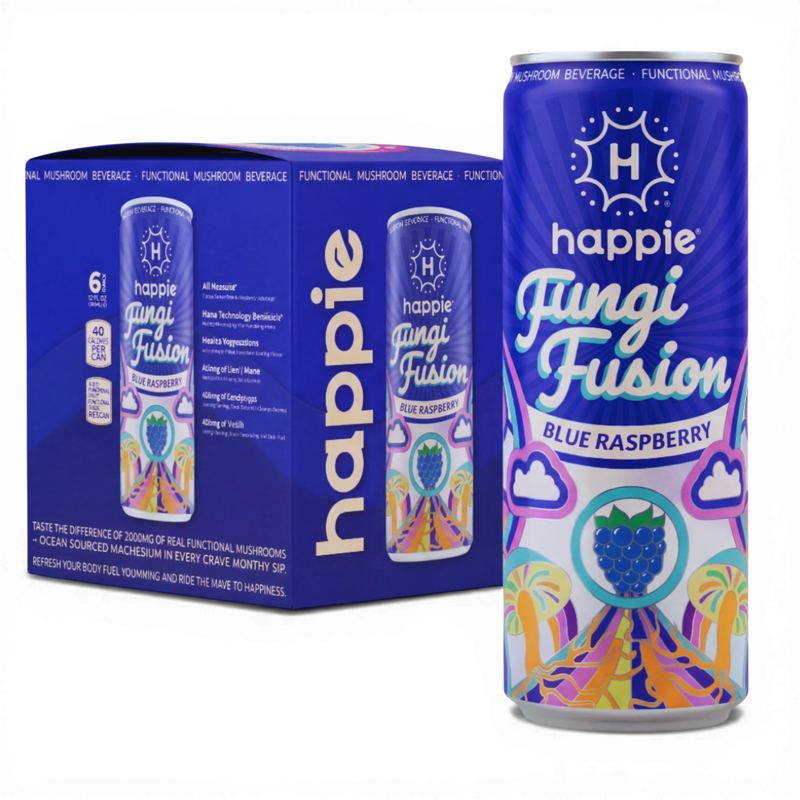
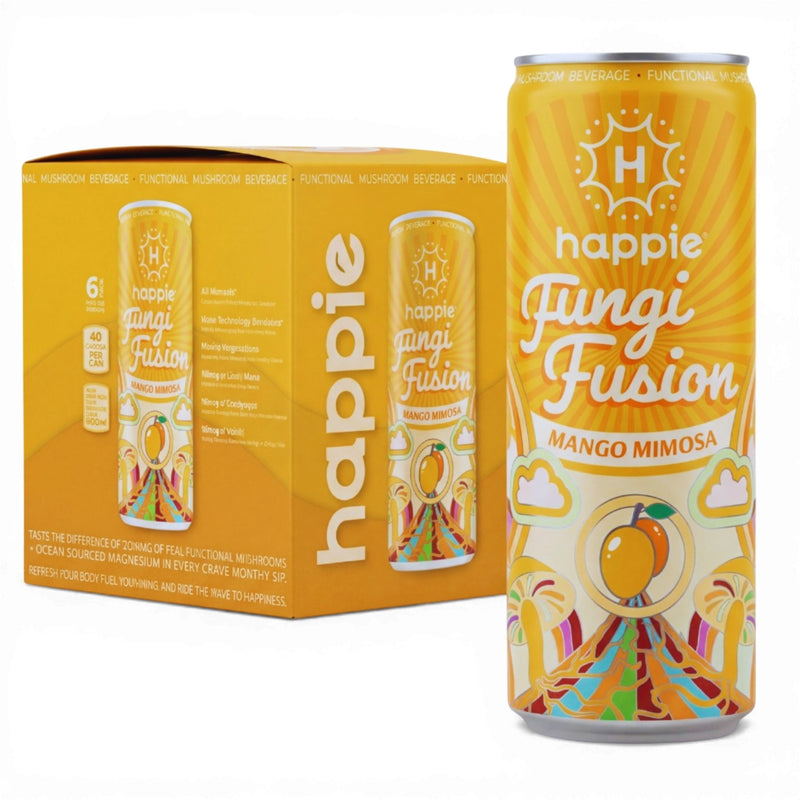
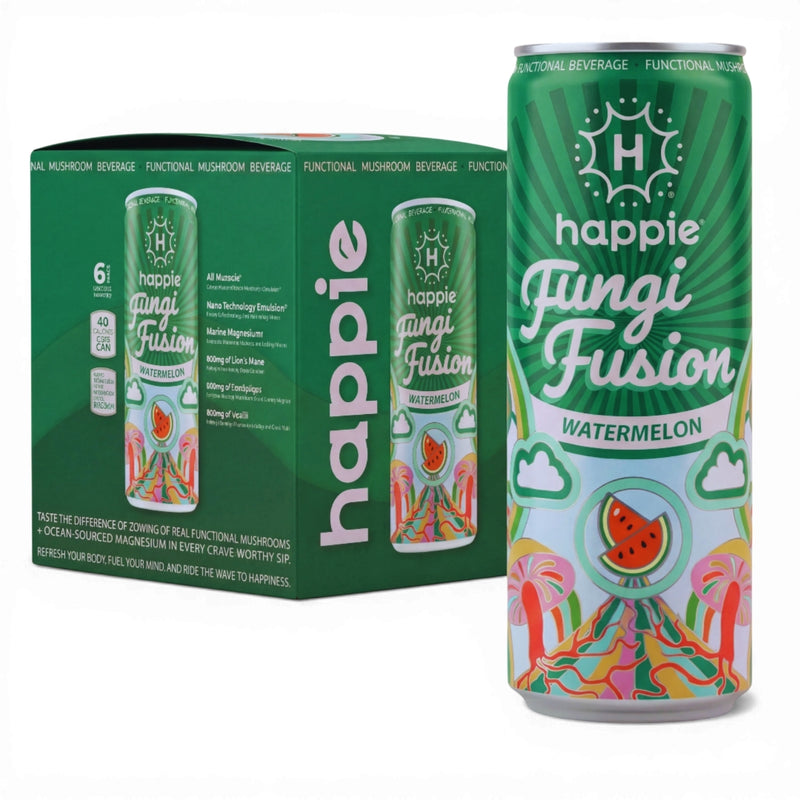
A quality functional mushroom drink is built around dual-extracted mushroom actives at meaningful doses, not a pinch of mushroom powder for label decoration. In Happie's Fungi Fusion, each can delivers 900mg Lion's Mane, 700mg Cordyceps, and 400mg Reishi, dual-extracted (hot-water plus a 90-day alcohol extraction) for 3–7x bioavailability compared with raw powder.
Here's why "dual-extracted" is the phrase to look for. Some of a mushroom's compounds (like beta-glucans) are water-soluble; others (like triterpenes) are alcohol-soluble. A single extraction leaves half the toolkit on the table. Dual extraction captures both, which is the difference between a drink that lists mushrooms and a drink that actually carries a functional dose.
Fungi Fusion also adds 230mg of marine magnesium and 90mg of marine calcium from Aquamin — ocean-derived minerals that support everyday hydration, the exact thing alcohol works against. Each can is 40 calories with 9g of sugar, vegan, non-GMO, caffeine-free, and made with no artificial flavors or colors. Caffeine-free is deliberate: the point of an evening alcohol swap is to wind down, not to get wired.
Worth naming plainly for anyone comparing shelves: Fungi Fusion contains no THC and no alcohol. That keeps it available in all 50 states and appropriate for occasions — a work lunch, a morning hike, a pregnancy-friendly toast — where THC and alcohol both sit out.
Functional Mushroom Drinks vs. Alcohol: The Honest Comparison
Head to head, functional mushroom drinks win on next-day cost and functional payload, while alcohol still wins on one thing only: the specific disinhibited buzz some people are chasing. If what you actually want is the ritual, the flavor, and a clear head tomorrow, the mushroom drink is the better trade for most everyday occasions.
|
Factor |
Alcohol |
Functional Mushroom Drink |
|---|---|---|
|
Next-day feel |
Dehydration, poor sleep, hangover risk |
No hangover; supports hydration |
|
Functional ingredients |
None (empty calories) |
Lion's Mane, Cordyceps, Reishi + minerals |
|
Sleep quality |
Disrupts REM even at low doses |
Non-disruptive; caffeine-free |
|
Calories (per serving) |
~150 (wine) to 200+ (cocktail) |
~40 per can (Fungi Fusion) |
|
Occasion flexibility |
21+, not driving, off-work |
Any time, any state, driving fine |
|
The "buzz" |
Yes — its main draw |
No intoxication by design |
The verdict: if you're drinking to unwind, socialize, or hold something enjoyable while you cook, a functional mushroom drink does that job without the trade-offs. If your only goal is intoxication, no non-alcoholic drink replaces that — and that's an honest line worth drawing. Most sober-curious drinkers, though, aren't chasing the buzz. They're chasing the ritual. That's the swap that sticks.
How to Build the Swap Into Real Occasions
The swaps that last are anchored to a specific moment, not a vague resolution to "drink less." Pick the one occasion where alcohol is most automatic for you and replace only that first — the 6 p.m. cook, the Friday wind-down, the social round.
A few that work especially well:
-
The evening wind-down. Swap the after-work beer or glass of wine for a cold can while you make dinner. The cracking-open ritual is intact; the 3 a.m. wake-up isn't.
-
The social round. Bring your own six-pack to the backyard hang. You stay in the rhythm of "everyone's holding something," and you drive home clear.
-
The mid-week reset. The nights you'd have had "just one" out of habit are the easiest to reclaim — and where the next-morning difference is most obvious.
Pete's Perspective
After building Happie in the functional beverage space, the pattern I keep seeing in our customer feedback is that people don't quit alcohol in one grand gesture — they reallocate one occasion at a time. The messages we get most aren't "I went sober." They're "I swapped my Tuesday glass of wine and slept like a rock." When we were dialing in the Fungi Fusion formula, we specifically kept it caffeine-free and built it around a full functional dose precisely because our customers were reaching for it in the evening, in the exact slot a drink used to fill. Designing for the occasion, not just the ingredient, is the whole game.
What the Research Actually Says
The research on functional mushrooms is genuinely promising and still genuinely early — both things are true, and any brand telling you otherwise is overselling. Here's the honest state of the evidence for the three mushrooms in most functional drinks.
Lion's Mane and cognition. A frequently cited 2009 double-blind, placebo-controlled trial by Mori and colleagues, published in Phytotherapy Research, found that adults taking Lion's Mane showed improved scores on a cognitive assessment versus placebo — with benefits fading after they stopped. Most studies showing cognitive effects use daily doses in the 500mg–3,000mg range, which is why a meaningful per-serving dose matters more than a mushroom mention on the label.
Cordyceps and energy. Cordyceps has been studied for its role in cellular energy production and exercise performance, with a body of research (much of it on the cultivated Cs-4 strain) exploring stamina and oxygen utilization. Results are mixed and often use higher doses than a single beverage delivers, so the honest framing is "supportive, not a stimulant."
Reishi and calm. Reishi is the most traditional of the three, used for centuries for its calming, balancing reputation. Modern clinical research is thinner and mostly early-stage, so we keep the language soft: Reishi is associated with a sense of calm and balance, not a treatment for anything.
The through-line: functional mushrooms aren't magic, and they aren't medicine. They're well-studied, food-grade ingredients that a growing base of evidence connects to focus, energy, and calm — which makes them a substantive upgrade over a beverage whose only active ingredient is ethanol.
How to Choose a Mushroom Drink Worth Swapping For
The best mushroom drink to replace alcohol is one with a disclosed, meaningful dose of dual-extracted mushrooms, no caffeine if you're drinking it at night, and full transparency about what's in the can. Most "mushroom" beverages on the shelf fail at least one of those tests.
Run any candidate through five quick checks:
-
Is the dose disclosed and meaningful? Look for hundreds of milligrams per mushroom, not a proprietary blend that hides the amounts. Fungi Fusion lists 900mg Lion's Mane, 700mg Cordyceps, and 400mg Reishi per can.
-
Is it dual-extracted? Water-plus-alcohol extraction captures both the beta-glucans and the triterpenes. Single-extraction or raw powder leaves function behind.
-
Is it caffeine-free? For an evening or wind-down swap, caffeine defeats the purpose. Check the label — many "energy mushroom" drinks are loaded with it.
-
Is the full panel clean? Calories, sugar, artificial colors and flavors. Fungi Fusion is 40 calories, 9g sugar, vegan, non-GMO, with no artificial anything.
-
Is there transparency behind it? Batch testing, clear sourcing, and a brand that will tell you what's not in the can (no THC, no alcohol) as readily as what is.
Frequently Asked Questions
Can mushroom drinks really replace alcohol?
Mushroom drinks can replace the ritual and occasion of alcohol very effectively, but they do not reproduce alcohol's intoxication — and that's intentional. For the large and growing group of sober-curious drinkers who want the flavor, the cold-can ritual, and a clear head the next morning without the buzz, a functional mushroom drink is a direct, satisfying swap. If intoxication is the specific goal, no non-alcoholic beverage substitutes for that.
Do functional mushroom drinks get you high?
No. Functional mushroom drinks made with Lion's Mane, Cordyceps, and Reishi are non-psychoactive and do not get you high. These are functional culinary and adaptogenic mushrooms — completely different from psilocybin ("magic") mushrooms. Happie Fungi Fusion also contains no THC and no alcohol, so there is no intoxication of any kind.
Are mushroom drinks better than alcohol for sleep?
For most people, yes — mushroom drinks are a better nighttime choice than alcohol for sleep. Alcohol is known to disrupt REM sleep even at low doses, which is why "nightcap" drinkers often wake at 3 a.m. A caffeine-free functional mushroom drink like Fungi Fusion won't chemically disrupt your sleep cycle, and Reishi is traditionally associated with calm. Individual results vary, and this isn't medical advice.
When should I drink a functional mushroom drink instead of alcohol?
The easiest place to start is the single occasion where alcohol is most automatic for you — typically the evening wind-down or a social gathering. Swap that one moment first: a cold Fungi Fusion while you cook, or your own six-pack at a backyard hang. Because it's caffeine-free and alcohol-free, it fits any time of day and any state, including occasions where alcohol isn't an option at all.
Is there a functional mushroom drink that works as an alcohol alternative in all 50 states?
Yes. Because Happie Fungi Fusion contains no THC and no alcohol, it's available and appropriate nationwide — unlike THC or CBD beverages, whose legality varies by state. That makes it a reliable non-alcoholic functional drink for travel, work-adjacent occasions, and anywhere an alcohol or cannabis beverage would be off the table.
The Swap, in a Can
If you've been looking for a functional mushroom drink as an alcohol alternative that actually earns its place in the glass, that's exactly what we built Happie Fungi Fusion to be. Each can carries a real functional dose — 900mg Lion's Mane, 700mg Cordyceps, 400mg Reishi — plus Aquamin ocean minerals for hydration, at 40 calories and zero caffeine, alcohol, or THC. It comes in Mango Mimosa, Blue Raspberry, and Watermelon, in a 6-pack for $23.99 — the same format and price rhythm as the drinks it's replacing.
Start with one occasion. Put a cold can in the glass where the wine or the beer usually goes, and notice how the next morning feels. Explore the full lineup on the Fungi Fusion collection (drinkhappie.com/collections/fungi-fusion), and if you're weighing the THC route for 21+ occasions in legal states, our founders break that down in "THC Drinks as an Alcohol Alternative" (drinkhappie.com/blogs/news/thc-drinks-as-an-alcohol-alternative-two-founders-compare-notes).
The sober-curious wave isn't about giving something up. It's about trading up. We put the fun in functional — one swapped occasion at a time.
About the author: Pete Olander is the Founder & CEO of Happie Beverages, maker of Fungi Fusion functional mushroom drinks and hemp-derived Delta-9 THC beverages. Before Happie, Pete worked in risk at J.P. Morgan and in product formulation at Nutrition53, experience he now applies to building transparent, functional beverages rooted in NorCal plant-medicine culture.
Share:
Shop the Lineup
Pair what you just read with the drinks made for it.



-

The THC Drink Ban Has Two Deadlines Now, Not One
The hemp THC deadline moved to December 11 — but one class of product still loses legal status November 12. Which date applies to what, from a founder inside it. -

Mushroom Drinks Instead of Alcohol: The Sober-Curious Swap That Actually Sticks
Swapping alcohol for mushroom drinks? Here's how functional mushroom drinks work as an alcohol alternative — the science, the ritual, and how to choose.
-

Fruiting Body vs Mycelium: The Mushroom Supplement Difference That Actually Matters
Fruiting body vs mycelium: the mushroom supplement difference that decides whether you are drinking real potency or the grain it was grown on.


