


Lion's Mane Drinks vs. Powders vs. Capsules: Which Format Actually Works?
The Lion’s Mane shelf has split into three camps — drinks, powders, and capsules — and most buyers pick a format based on habit rather than chemistry. That’s a mistake. Format determines how much of the mushroom your body actually absorbs, how quickly it works, and whether you’ll still be taking it ninety days from now.
This is the guide we wish existed when we started formulating Happie’s Fungi Fusion line. We tested every format on the shelf, read the extraction research, and had the same conversations with thousands of Happie customers that Lion’s Mane shoppers are having right now: Does the format matter, or is Lion’s Mane just Lion’s Mane?
Short answer: it matters a lot. Here’s the long answer — and a framework for picking the format that fits the life you actually live.
Table of Contents
- Why the Format Debate Actually Matters
- How Lion’s Mane Actually Works Inside the Brain
- Lion’s Mane Drinks: What the RTD Format Does Well
- Lion’s Mane Powders: Where Powders Win and Where They Don’t
- Lion’s Mane Capsules: The Case For and Against
- Head-to-Head: Drink vs. Powder vs. Capsule
- What the Research Says About Dose and Bioavailability
- Happie Fungi Fusion: What We Built and Why
- Frequently Asked Questions
- Where the Category Is Going Next
Why the Format Debate Actually Matters
Format determines three things that decide whether Lion’s Mane works for you: the dose you actually consume, how well your body absorbs it, and whether you’ll keep taking it long enough to notice anything. All three get decided before you ever swallow the mushroom.
A capsule delivers a precise dose but depends on dry biomass quality. A powder gives you flexibility but only works if you’ll realistically stir it into something every morning. A drink locks the dose and the ritual together, which is why retention rates for functional beverages consistently outperform powders and capsules in DTC data.
The functional mushroom category has grown roughly 15% year over year, and the drink segment is the fastest-growing piece of it — not because drinks are objectively better, but because the format solves the two problems that kill mushroom routines: inconsistent dosing and inconsistent habits. The question isn’t which format is "best" in isolation. It’s which format matches the life you actually live.
Pete’s Perspective — When we were developing Fungi Fusion, the first question we had to answer wasn’t "which mushrooms" — it was "why would anyone keep drinking this after week two." Six years running Happie and thousands of customer conversations later, the pattern is obvious: adults who get noticeable benefit from functional mushrooms almost always have a ritual attached to their dose. The powder in the back of the cabinet delivers zero milligrams. The can you open with lunch delivers exactly what’s on the label.
How Lion’s Mane Actually Works Inside the Brain
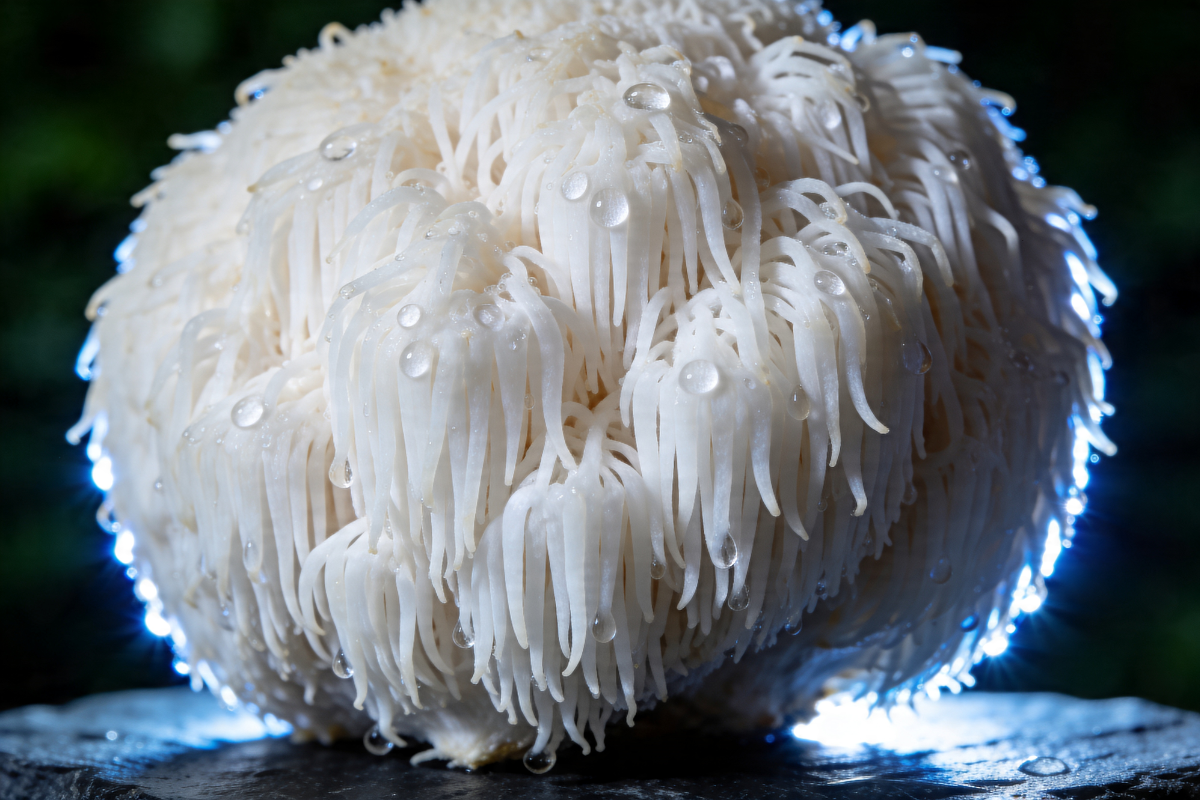
Lion’s Mane (Hericium erinaceus) stimulates the production of two proteins that signal your brain to grow and repair neurons: Nerve Growth Factor (NGF) and Brain-Derived Neurotrophic Factor (BDNF). Those proteins support the hippocampus and prefrontal cortex — the regions responsible for memory, learning, and executive function. The effect is structural, not stimulant.
That matters for the format conversation. Because Lion’s Mane doesn’t produce an acute, same-day "hit" the way caffeine does, the value of any format is entirely about consistency over weeks. A 2009 double-blind trial published in Phytotherapy Research (Mori et al.) gave 500mg of Lion’s Mane extract three times daily to adults aged 50–80 with mild cognitive impairment. After 8–16 weeks, the Lion’s Mane group showed statistically significant improvement on cognitive function scores versus placebo. When supplementation stopped, scores regressed over the following four weeks. The signal is clear: the mushroom works if it’s in your system continuously, and the effect is not instant.
This is the piece most Lion’s Mane content skips. If the format you pick makes you miss doses — because the powder tastes like dirt, the capsule reminds you of "taking pills," or the drink isn’t available when you need it — the format has failed, no matter how clinical the lab report looks.
Two other mechanics shape the format debate:
Extraction method determines what’s actually in the product. Raw Lion’s Mane contains two classes of bioactive compounds: beta-glucans (water-soluble immune modulators) and triterpenes / hericenones / erinacines (alcohol-soluble compounds linked to the NGF and BDNF response). Hot-water extraction pulls the beta-glucans. Alcohol extraction pulls the triterpenes. If a product only uses one extraction method, you’re getting half the mushroom.
Dual-extracted Lion’s Mane delivers roughly 3–7x the bioavailability of raw, non-extracted mushroom powder, according to methodology summarized in the Journal of Ethnopharmacology. That’s the difference between a product that works and a product that doesn’t — and it has nothing to do with format. A dual-extracted capsule at 500mg often outperforms a non-extracted powder at 2,000mg.
Format and extraction are separate questions. Both have to be right.
Lion’s Mane Drinks: What the RTD Format Does Well
Ready-to-drink Lion’s Mane delivers a pre-measured, bioavailable dose in a format that attaches to an existing habit — opening a can with lunch, replacing the afternoon soda, having something to hold at a social event. That ritual anchor is the RTD category’s actual superpower. The compliance problem — remembering to take the mushroom — gets solved by accident.
RTD drinks also win on formulation transparency. When a dose is printed on a nutrition panel (as with Happie Fungi Fusion’s 900mg per can), the manufacturer can’t hide behind "proprietary blend" language. That label precision is why RTDs have become the preferred format for functional ingredient benchmarking in consumer testing.
Where drinks lose ground: cost per milligram and dose flexibility. At roughly $4 per can for 900mg of Lion’s Mane, an RTD is priced for experience rather than maximum throughput. If your goal is to self-stack 2,000mg+ daily for an aggressive cognitive protocol, a powder or capsule will cost less per gram. But for the vast majority of adults who want a noticeable functional dose tied to a consumable ritual, RTD is the format that delivers.
The other structural issue for the category is caffeine. Most mushroom RTDs on the market — including the closest RTD competitor, Odyssey — pair mushrooms with coffee or matcha. That’s fine for the morning crowd, but it eliminates the drink as an afternoon or evening option. A caffeine-free functional mushroom drink is genuinely rare in the category, which is the specific white space Happie Fungi Fusion was built to fill.
Lion’s Mane Powders: Where Powders Win and Where They Don’t
Lion’s Mane powders deliver the best cost-per-milligram in the category — typically $1 to $2 per serving for products like MUD/WTR, RYZE, Four Sigmatic, and Everyday Dose — and let you scale your own dose precisely. For high-dose protocols or for buyers who already have a morning smoothie or coffee ritual to stir into, powder is hard to beat on value.
The catch is that powder format magnifies every other variable. Taste is unforgiving — the earthy, slightly bitter flavor of Lion’s Mane gets masked by coffee in products like MUD/WTR and Four Sigmatic, but becomes the reason most users quit within 30 days when the powder is unflavored. Dosage drift is real: when a scoop is "about a teaspoon," three mornings in a row of eyeballed measurements adds up to 20–30% variance. And extraction quality is harder to verify on powders because the product is sold by total weight, not by extract concentration.
Four Sigmatic, MUD/WTR, RYZE, and Everyday Dose all solved the taste problem by marrying Lion’s Mane to coffee. That works — RYZE’s national Target launch in January 2026 validated the format at mass retail — but it ties the mushroom to the morning and to caffeine. If you want Lion’s Mane without coffee, or without the jitters, the powder aisle thins out fast.
Powders work best for: high-throughput dosing, coffee-compatible routines, and buyers who already have a reliable morning ritual. Powders work worst for: afternoon occasions, caffeine-sensitive users, and anyone who has ever bought a tub of something functional and watched it gather dust.
Lion’s Mane Capsules: The Case For and Against
Capsules solve three problems that drinks and powders can’t: portability, precision, and flavor neutrality. A capsule delivers an exact milligram dose with no taste, no prep, and no temperature requirements — which is why capsule Lion’s Mane has been the default format in supplement aisles for two decades. If the goal is "take Lion’s Mane every day without thinking about it," capsules are efficient.
Where capsules fall short is experience and verifiability. There’s no ritual, no flavor, and no reminder that you’ve actually taken the dose — which is exactly why capsule routines have the highest drop-off rate of the three formats in DTC supplement data. "I forgot" is the number one reason people stop taking capsules at day 30. And because capsules hide the product inside a gelatin shell, extraction quality and mushroom-part sourcing (fruiting body vs. mycelium on grain) become harder to verify visually. Many budget Lion’s Mane capsules on the market are mycelium-on-grain rather than pure fruiting body, which dilutes the bioactive content significantly.
Capsules work best for: travelers, dose stackers, and anyone already on a daily supplement stack who wants to add Lion’s Mane without changing habits. Capsules work worst for: first-time users who want to feel whether the mushroom is working, and anyone whose supplement drawer is already full of half-empty bottles.

Head-to-Head: Drink vs. Powder vs. Capsule
Each format wins a different buyer. The comparison below is the same framework we use internally when we get asked "which format should I start with?"
| Factor | Drink (RTD) | Powder | Capsule |
|---|---|---|---|
| Dose precision | High (printed on label) | Low-medium (scoop variance) | High (pre-measured) |
| Bioavailability ceiling | High (if dual-extracted) | High (if dual-extracted) | High (if dual-extracted) |
| Cost per 1,000mg | ~$4.40 | ~$1.50 | ~$1.20 |
| Taste / experience | Full ritual, flavored | Mixed (often masked by coffee) | None |
| Compliance rate at 30 days | Highest | Medium | Lowest |
| Caffeine-free options | Available (Happie Fungi Fusion) | Rare (most = coffee blends) | Common |
| Portability | Medium (can) | Low (container + liquid) | Highest |
| Best for | Ritual + social use | High-dose daily protocols | Stackers / travelers |
The verdict isn’t universal — it’s situational. For adults who want to feel whether Lion’s Mane is doing anything, build a sustainable daily habit, and have the mushroom show up in afternoon or social occasions, a caffeine-free RTD wins on compliance and experience. For high-dose protocol users with an existing morning routine, powder wins on cost per gram. For travelers and stackers, capsules win on convenience. Pick the format that matches how you’ll actually use it — not the format with the best label copy.
What the Research Says About Dose and Bioavailability
The clinical dose range for Lion’s Mane cognitive research sits between 500mg and 3,000mg of extract per day, with most peer-reviewed trials landing in the 750mg–1,500mg range across 8–16 week protocols. Below 500mg, the research thins out quickly. Above 3,000mg, the evidence for additional benefit doesn’t scale linearly — and the cost per dose rises steeply.
Three studies anchor the category:
- Mori et al. (2009), Phytotherapy Research — Double-blind placebo-controlled trial, 500mg Lion’s Mane extract three times daily, adults 50–80 with mild cognitive impairment. Statistically significant improvement in cognitive function scores at weeks 8, 12, and 16. Effect regressed after supplementation stopped.
- Saitsu et al. (2019), Biomedical Research — 12-week trial of 1,800mg Lion’s Mane extract in healthy adults, showed improvement in cognitive function and mood scales versus placebo. Reinforces the 1,000–2,000mg range as a practical functional target.
- Docherty et al. (2023) — Acute-dose human trial showing Lion’s Mane can produce measurable effects on speed of performance within 60 minutes of a single dose. This was the first research to suggest an acute, same-day signal in addition to the chronic structural effect documented in Mori. Still early data, but it reframes the "Lion’s Mane only works after weeks" story.
The practical takeaway: any format that consistently delivers 750mg–1,500mg of dual-extracted Lion’s Mane per day sits inside the evidence-backed range. Happie Fungi Fusion’s 900mg per can lands in the middle of that range by design — high enough to match the Saitsu and Mori protocols at one can per day, low enough to avoid the diminishing-returns curve that starts above 2,000mg.
Pete’s Perspective — The 900mg decision wasn’t arbitrary. Early in formulation we tested 500mg, 900mg, and 1,500mg versions against our customer panel. 500mg felt like it was doing almost nothing by week two. 1,500mg felt great on paper but pushed us into a cost structure that would have put us over $5 per can at retail — and we’ve learned the hard way, both from Happie and from my years formulating at Nutrition53, that functional beverages die the second they cross the $5 price ceiling. 900mg landed in the sweet spot: inside the clinical window, sustainable at $4 per can, and high enough that regular drinkers actually notice the difference.
Happie Fungi Fusion: What We Built and Why

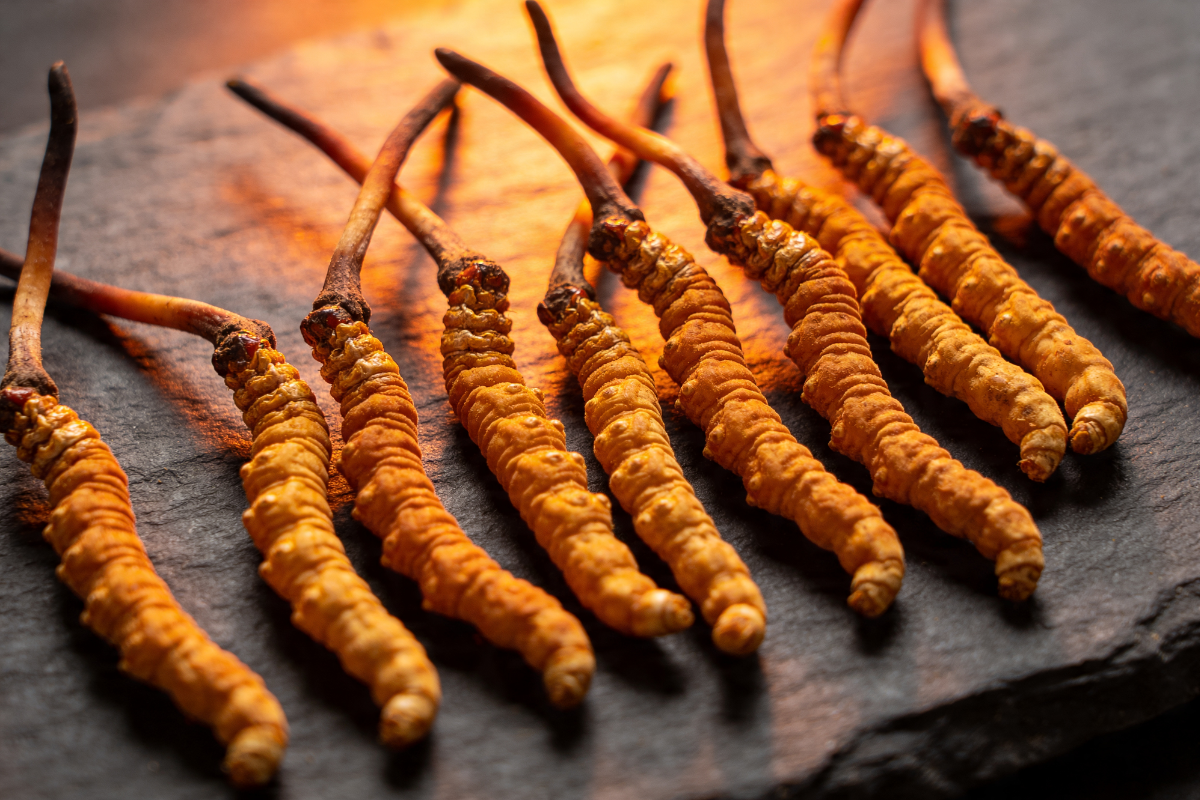
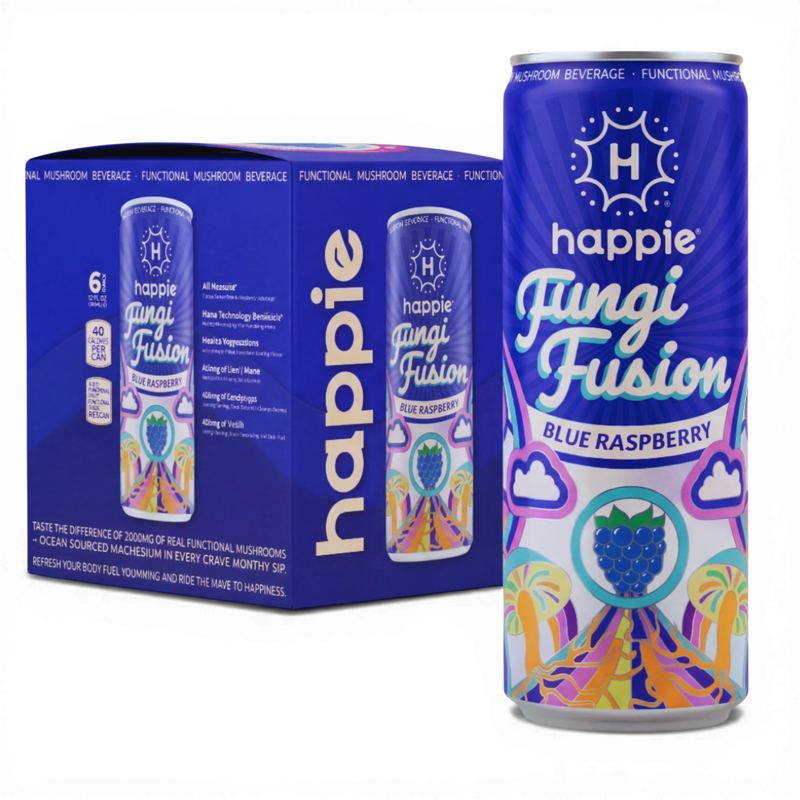
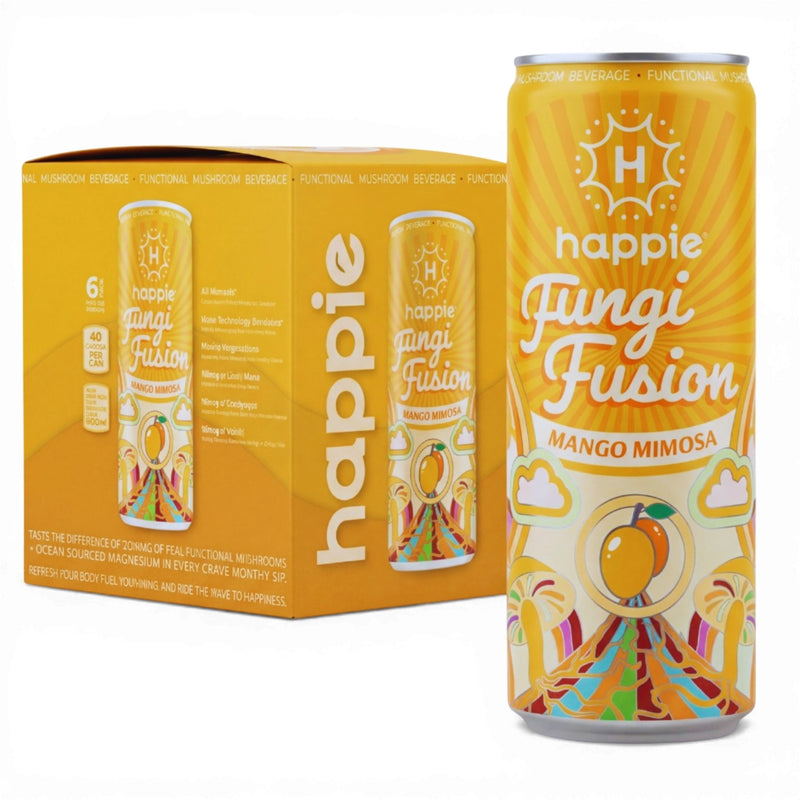
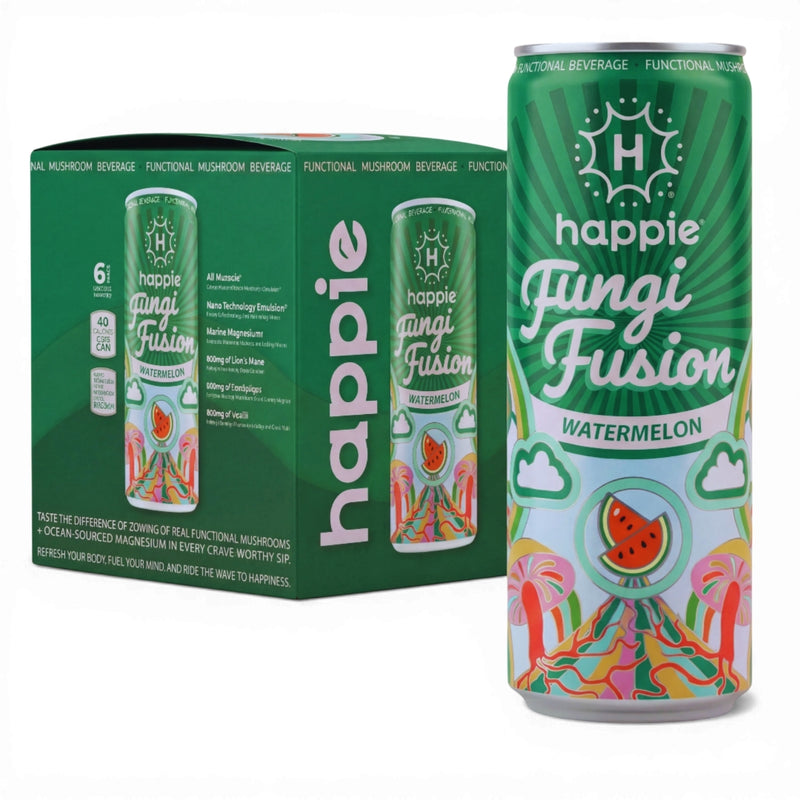
Happie Fungi Fusion is the caffeine-free, dual-extracted functional mushroom RTD we wanted to exist — and didn’t. Every can delivers 900mg Lion’s Mane, 700mg Cordyceps, and 400mg Reishi, all dual-extracted (fermentation, hot water, and 90-day alcohol extraction) for 3–7x the bioavailability of non-extracted mushroom powder. Each can adds 230mg of marine magnesium and 90mg of marine calcium (Aquamin) for hydration support. 40 calories, 9 grams of sugar, vegan, non-GMO, no artificial flavors or colors, and zero caffeine.
Format choice drove every formulation decision. Because Fungi Fusion is a drink, the dose has to be right the first time — there’s no scoop adjustment. Because it’s caffeine-free, it has to work across the full day without stacking on someone’s coffee. Because it’s built for a ritual, the flavors — Mango Mimosa, Blue Raspberry, Watermelon, with Blackberry Lemon and Strawberry in development — had to taste good enough that the can is the reward, not the penalty.
Who Fungi Fusion is built for: Anyone who wants a noticeable functional dose without a supplement routine. Afternoon-energy seekers without the jitters. Coffee-tired drinkers who want the Lion’s Mane benefit without the caffeine. Anyone building an alcohol-alternative ritual. Travelers who don’t want to pack capsules.
Who’s better served by powder or capsules: High-dose daily protocol users who want 2,000mg+ of Lion’s Mane and prefer cost per gram over ritual. Stackers with fifteen supplements already dialed in. Buyers who genuinely don’t care about taste or occasion.
Pick the format that matches how you’ll actually use it. If that’s Fungi Fusion, browse the full line — or read our deeper dive on why Lion’s Mane dosage matters and our comparison of functional mushroom drinks vs. adaptogen drinks to benchmark Fungi Fusion against the broader functional beverage space.

Frequently Asked Questions
Is a Lion’s Mane drink better than a capsule?
A Lion’s Mane drink is better than a capsule for most adults because the ritual of opening and drinking a can drives higher 30-day and 90-day compliance than pill-based routines. Capsules win on portability and price per gram. Drinks win on consistency of use — and Lion’s Mane only works if it’s actually in your system. For first-time users, a drink is the more reliable path to noticing whether the mushroom is working.
How much Lion’s Mane do you need per day?
Most peer-reviewed cognitive research on Lion’s Mane uses 500mg to 3,000mg of extract per day, with the strongest results clustering in the 750mg–1,500mg range across 8–16 week protocols. Happie Fungi Fusion delivers 900mg of dual-extracted Lion’s Mane per can, which sits inside that clinical window at one can daily.
Do Lion’s Mane drinks actually work?
Lion’s Mane drinks work if two things are true: the product uses dual-extracted Lion’s Mane (hot water plus alcohol extraction), and you consume it consistently for 8 or more weeks. Format is not the active ingredient — extraction quality, dose, and compliance are. A dual-extracted 900mg RTD outperforms a non-extracted 2,000mg powder because bioavailability, not raw weight, determines what actually reaches your brain.
What is dual-extracted Lion’s Mane?
Dual-extracted Lion’s Mane is processed using both hot water (to pull out beta-glucans) and alcohol (to pull out triterpenes, hericenones, and erinacines). Single-extraction products capture only one of those compound classes and miss significant portions of the bioactive material. Dual-extracted Lion’s Mane delivers roughly 3–7x the bioavailability of raw, non-extracted mushroom powder.
Can you drink Lion’s Mane every day?
You can drink Lion’s Mane daily. The clinical research protocols run continuous daily dosing for 8 to 16 weeks, and in the Mori et al. 2009 study, cognitive gains regressed when supplementation stopped — indicating that daily, sustained use is the intended protocol. Lion’s Mane has a strong safety profile in peer-reviewed trials, with no serious adverse effects reported at typical functional doses.
Does Happie Fungi Fusion have caffeine?
Happie Fungi Fusion is caffeine-free. That’s intentional — most mushroom RTDs on the market pair functional mushrooms with coffee or matcha, which ties the product to the morning and excludes caffeine-sensitive adults. Fungi Fusion is built for all-day use: morning focus without jitters, afternoon lift without an evening crash, and evening wind-down without worrying about sleep disruption.
Where the Category Is Going Next
The functional mushroom beverage category is moving the same direction every functional category eventually moves: toward precision. In five years, picking between Lion’s Mane drink, powder, and capsule will feel about as outdated as picking between whey protein powder and whey protein bars — the answer will be "both, for different moments." Format will stop being a tribal identity and start being a tool.
The more interesting shift is already starting: functional mushroom drinks are decoupling from coffee. When every RTD in the category is caffeinated, the category ceiling is capped at the morning occasion. When the category splits into caffeinated and caffeine-free, the number of daily occasions a functional mushroom drink can own roughly triples. That’s the wedge Happie Fungi Fusion is built on, and based on what we’re seeing in DTC cart data and distributor conversations, we don’t think that wedge stays unique for long.
The best thing you can do right now: pick the format you’ll actually use for the next 90 days, verify it’s dual-extracted, and check that the dose on the label is inside the clinical window. Everything else is marketing.
Try Happie Fungi Fusion — caffeine-free, dual-extracted, 900mg Lion’s Mane per can. Built for the format choice we wished existed.
Pete Olander is the Founder & CEO of Happie Beverages. Before Happie, Pete spent years formulating functional products at Nutrition53 and brings operator experience from roles at J.P. Morgan. This post reflects six years of formulation, sourcing, and customer-conversation work building Happie’s Fungi Fusion line.
Share:
Shop the Lineup
Pair what you just read with the drinks made for it.



-

Mushroom Drinks Instead of Alcohol: The Sober-Curious Swap That Actually Sticks
Swapping alcohol for mushroom drinks? Here's how functional mushroom drinks work as an alcohol alternative — the science, the ritual, and how to choose.
-

Fruiting Body vs Mycelium: The Mushroom Supplement Difference That Actually Matters
Fruiting body vs mycelium: the mushroom supplement difference that decides whether you are drinking real potency or the grain it was grown on. -

Lion's Mane vs Cordyceps: Which Mushroom Do You Actually Need?
Lion's mane sharpens focus; cordyceps fuels energy. Here's what the research actually shows on each — and why the smartest move is stacking both in one can, not choosing between them.


