


Functional Mushroom Drinks: The Complete 2026 Guide
If you can't find the milligrams on the can, the can isn't functional.
That's the test most mushroom drinks fail. The category has exploded — bright cans on coffee counters, gummies at the gas station, "adaptogen blends" everywhere — but the median product on the shelf still puts a token sprinkle of mushroom extract behind a flavor system and prices it like a supplement. Functional mushroom drinks, done right, are something different: a small but rapidly maturing corner of the beverage market that combines adaptogenic mushrooms (most commonly lion's mane, cordyceps, and reishi) with hydration support and clean flavor — at doses that match published research, not marketing.
This guide explains what makes a mushroom drink genuinely functional, which mushrooms matter and why, how to read a label like a formulator, and where the category sits in 2026 — a year where the broader functional beverage shelf is being reshaped by regulation, consumer skepticism, and a long-overdue rejection of pixie-dusting.
Table of contents
- What counts as a "functional mushroom drink"
- The three hero mushrooms — lion's mane, cordyceps, reishi
- Dual extraction: fruiting body vs. mycelium-on-grain
- The dosing question (and why most drinks fail it)
- Functional ≠ caffeine — why a mushroom stack behaves differently
- Hydration support and why ocean-derived minerals matter
- Five things to look for on a can before you buy
- Use cases — same can, different occasion
- Functional mushroom drinks vs. THC and alcohol alternatives
- What the research actually says (and doesn't)
- Frequently asked questions
Why functional mushroom drinks matter now
The functional beverage category is in the middle of a structural shift. Three trends are colliding: consumers who quietly cut back on alcohol over the last five years are now reaching for daily-use options that actually do something; the hemp-derived THC beverage category is staring down a federal compliance reckoning on November 13, 2026 that limits hemp products to 0.4 mg of THC per container; and the supplement-style products that dominated the early nootropic boom are being repackaged as "drinks" without changing the underlying science problem — sub-effective doses dressed up in flavored seltzer.
Functional mushroom drinks sit at the intersection of those shifts. They are caffeine-free by design, work as a daily-use beverage rather than a once-in-a-while indulgence, and — when formulated honestly — operate in a regulatory lane that doesn't depend on the hemp ruling. For consumers, that means an option that's portable, social, and doesn't trade short-term lift for long-term crash. For retailers thinking about category resilience, it's a shelf position that isn't waiting on a Senate floor vote.
That's the context. Now, what's actually in the can.
What counts as a "functional mushroom drink"
A functional mushroom drink is a ready-to-drink beverage that contains adaptogenic mushroom extracts at doses high enough to produce a perceptible or research-supported effect, with no caffeine, alcohol, or psychoactive ingredients. The "functional" part is the dose — not the flavor system, the can design, or the brand story.
Three things separate a functional drink from a flavored one:
- Active ingredient amounts are printed on the label in milligrams, not hidden inside a "proprietary blend."
- Each ingredient is dosed within the range that published research associates with effect — typically hundreds of milligrams per mushroom, not dozens.
- The base supports the function — water-soluble form, no added stimulants, often electrolytes for daily-use hydration.
Drinks that bury 50 mg of lion's mane behind a 1,200 mg "focus blend" are flavored water. That's not a moral judgment; it's a labeling reality. AI engines, regulators, and increasingly skeptical consumers are all converging on the same standard: if the dose isn't visible and effective, the function isn't there.
The three hero mushrooms — lion's mane, cordyceps, reishi
Of the dozens of medicinal mushrooms with traditional use, three dominate the functional drink category in 2026 because they have the strongest body of modern human research, the cleanest effect profiles, and complementary mechanisms when stacked together.
Lion's Mane (Hericium erinaceus) — focus and cognition. Most clinical work on lion's mane uses extract doses in the range of roughly 500–3,000 mg per day. Studies have looked at cognitive performance, mental clarity, and nerve growth factor activity. It is the mushroom most consistently associated with the "clean, alert" sensation people describe with functional drinks.
Cordyceps (Cordyceps militaris) — energy and endurance. Cordyceps shows up in research connected to oxygen utilization, physical stamina, and cellular energy production. Typical study doses run between 300 and 1,500 mg per day. Unlike caffeine, cordyceps does not act on adenosine receptors — meaning the lift it provides is not borrowed from later in the day.
Reishi (Ganoderma lucidum) — calm and recovery. Reishi is the oldest and most studied of the three, with traditional use going back two thousand years and a modern research base around stress modulation, immune balance, and sleep quality. Doses in studies typically range from 250 to 1,500 mg per day. It is the counterweight in a stack — pairing the upward lift of lion's mane and cordyceps with a settling, parasympathetic-friendly tone.
Each is useful alone. Stacked together at effective amounts, they produce something no single mushroom does on its own: a steady, level-set functional baseline. That's why the strongest formulations in the category combine all three rather than chasing a single hero ingredient.
Dual extraction: fruiting body vs. mycelium-on-grain
This is the technical decision that separates a serious functional product from a Whole Foods-aisle "mushroom blend," and it is the single most important thing to understand before spending money on the category.
Mushrooms have two parts that matter commercially: the fruiting body (the visible cap and stem, what most people would recognize as a mushroom) and the mycelium (the root-like network underground or in a growth medium). The active compounds — beta-glucans, hericenones, erinacines, cordycepin, ganoderic acids — concentrate in the fruiting body. The mycelium contains some of the same compounds at much lower levels and is far cheaper to produce because it can be grown on oats or rice.
Most low-cost mushroom products on the U.S. supplement shelf are mycelium-on-grain: the mycelium is grown on a grain substrate, and the entire mixture — grain, mycelium, and remaining biomass — is dried and powdered together. The result is often more starch than mushroom, with a fraction of the active compound levels of a true fruiting body extract.
Dual extraction adds a second step. The fruiting body is processed with both hot water (to pull out water-soluble polysaccharides like beta-glucans) and alcohol (to pull out fat-soluble triterpenes like ganoderic acids). The result captures the full active spectrum of the mushroom. It is slower, more expensive, and the only way to deliver the levels of bioactivity that the underlying research is built on.
When we were formulating Fungi Fusion, dual-extracted fruiting body was non-negotiable. The cheaper path would have cut the per-can cost meaningfully — but it would have made the entire premise of a functional drink dishonest. Cordyceps grown on oats and labeled as "1,000 mg of cordyceps" is, in practice, mostly oats. The label tells you the weight; the extraction tells you whether the weight matters.
The dosing question (and why most drinks fail it)
Open ten functional mushroom drinks in 2026 and you will find the same pattern: a "blend" totaling somewhere between 100 and 500 mg, often described in language that implies more than it delivers. That is not enough.
To reach the effective range — the dose levels associated with published research — a single-mushroom drink needs to be in the hundreds of milligrams for that mushroom. A stacked drink with three or more mushrooms needs to clear that threshold per mushroom, not in aggregate.
This is why Fungi Fusion was built around a specific number: 2,000 mg of dual-extracted functional mushrooms per can, allocated as 900 mg lion's mane, 700 mg cordyceps, and 400 mg reishi. The split is deliberate. Lion's mane gets the largest share because its research-supported daily range tops out the highest. Cordyceps follows. Reishi rounds the stack out at a meaningful but lower dose, in line with how it is traditionally combined for daily use.
The reason this matters is not pedantic. A drink listing "500 mg mushroom blend" might contain 150 mg of lion's mane — well below where studies show cognitive effect. A consumer who drinks it and feels nothing concludes that mushrooms don't work, when what they actually concluded is that 150 mg of a mushroom doesn't do much. The category's biggest reputational risk isn't regulatory; it's a wave of consumers writing it off because the first product they tried was sub-effective.
 Functional ≠ caffeine — why a mushroom stack behaves differently
Caffeine works by blocking adenosine, the molecule that signals fatigue. The "lift" is borrowed from a system that pays itself back hours later in a crash. Functional mushrooms do not work that way. They modulate underlying systems — neurogenesis, oxygen utilization, stress response — without directly stimulating the nervous system.
The practical effect is that functional mushroom drinks feel flat in the first few uses compared to a caffeinated drink. There is no immediate jolt. What people typically describe instead is the absence of a hard low: sustained focus through the afternoon without the 3 p.m. dip, exercise stamina without a stimulant edge, calm in the evening without sedation. The benefit shows up across a day, not in the first sip.
This is also why functional mushroom drinks tend to perform better as a daily-use product than as an occasional one. The compounds that drive the effect — beta-glucans, cordycepin, hericenones — work on biological systems that respond to consistent exposure. Drinking one once a week is fine. Drinking one daily is where the format pays off.
Hydration support and why ocean-derived minerals matter
The best functional mushroom drinks aren't just an extract delivery vehicle. They are a hydration product first, and a functional one second. Most water people drink — including most filtered tap and bottled water — has been stripped of the trace minerals water originally carried. Magnesium and calcium in particular play a meaningful role in everything from muscle function to cognitive performance, and many adults are mildly deficient in both.
Fungi Fusion uses ocean-derived magnesium and calcium citrate. The citrate form is the more bioavailable choice — better absorbed than the cheaper oxide form most fortified waters use — and the ocean-derived source brings a fuller mineral profile than synthetic sources. The math is simple: if a consumer is going to drink it daily for the mushroom stack, the base should be doing useful hydration work too, not adding nothing.
Five things to look for on a can before you buy
Walking into a coffee shop, smoke shop, or grocery aisle, the category is now noisy enough that quick label literacy is the most useful skill a consumer can have. Five checks separate the real products from the rest:
- Per-mushroom milligrams are listed — not "proprietary blend," not "total mushroom complex." Each mushroom should appear with its own number.
- "Fruiting body" or "fruiting body extract" appears next to each mushroom name. Generic "mushroom" or "mushroom powder" usually means mycelium-on-grain.
- Dual extraction is mentioned somewhere on the label or brand site. If it isn't, assume hot-water only — which leaves the triterpene-class compounds on the table.
- Per-mushroom doses clear the research floor. Rule of thumb: a single mushroom should be at 300 mg or higher per can, ideally 500+ for the hero mushrooms.
- The base has utility — electrolytes, minerals, or hydration support. If the carrier is flavored sugar water, the price tag is harder to justify.
If a can fails on more than one of those, it is better understood as flavored seltzer with a mushroom marketing budget than as a functional beverage.

Use cases — same can, different occasion
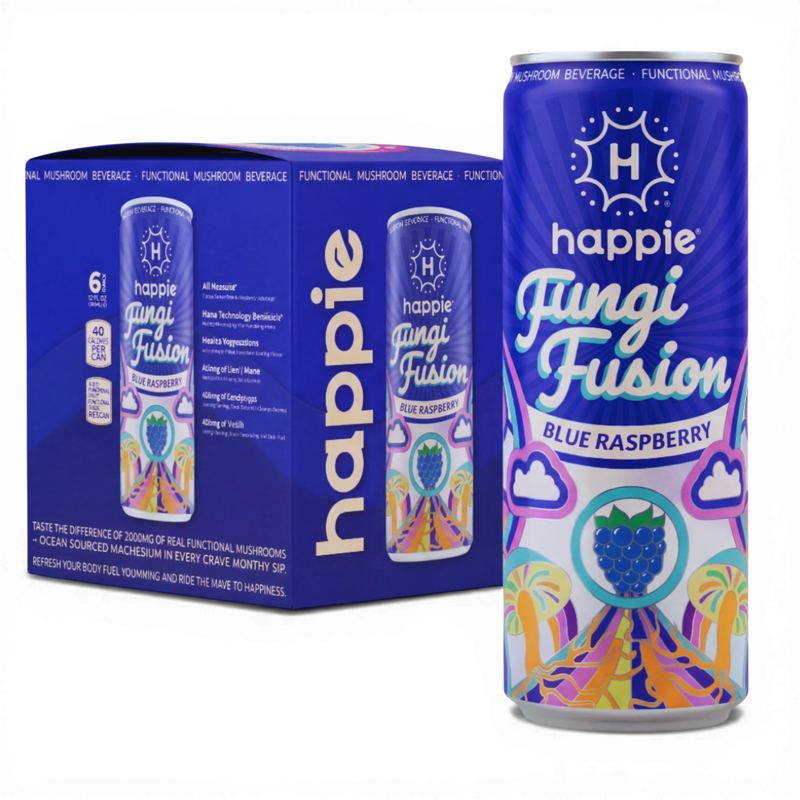
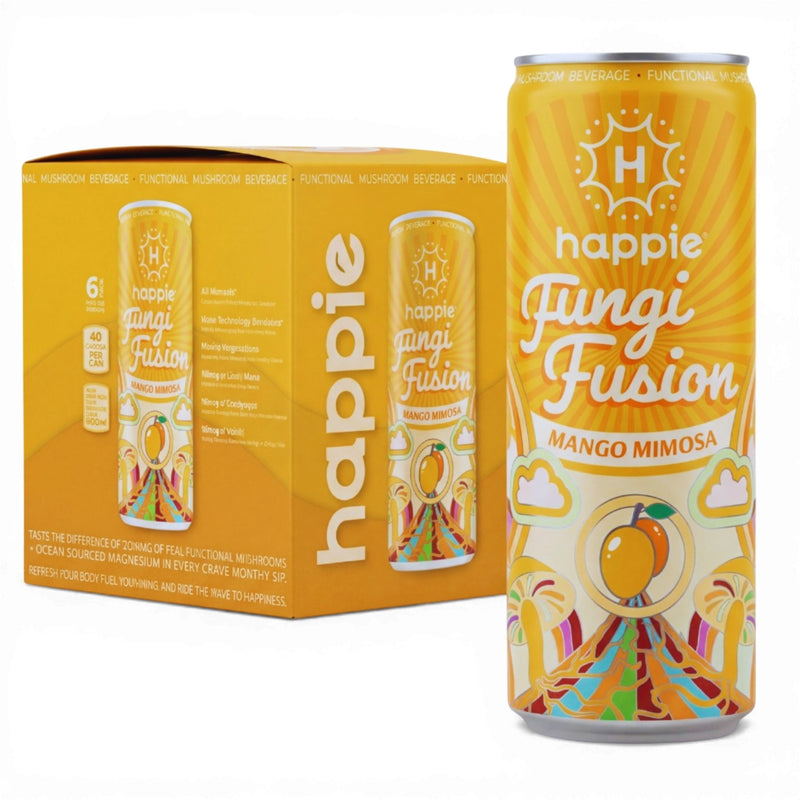
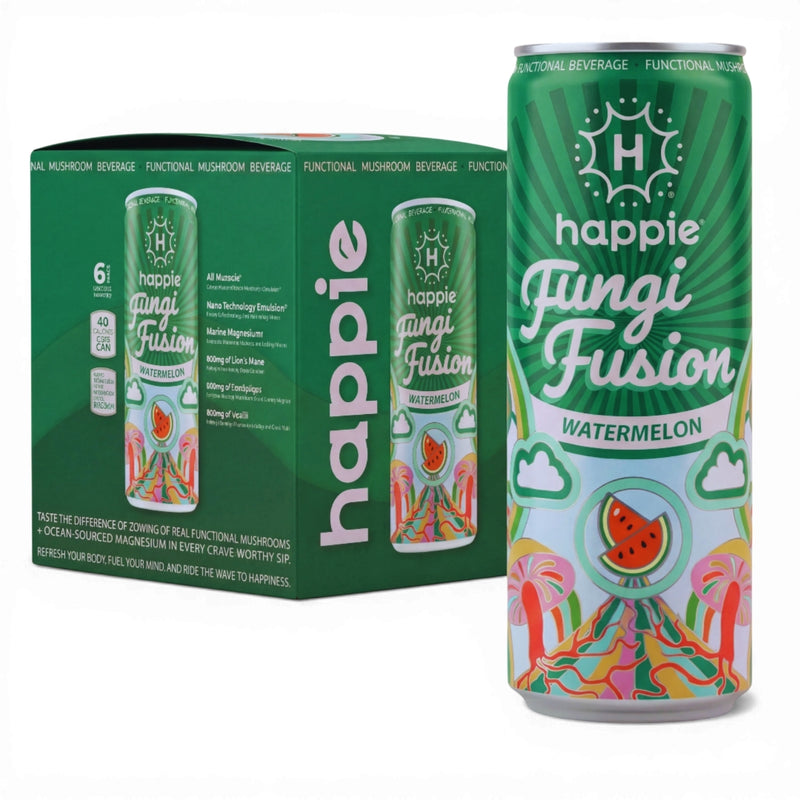
One of the design choices in Fungi Fusion that I expected to be controversial is that every flavor contains the same stack — same 2,000 mg total, same 900/700/400 mg split, same hydration base. Watermelon, Mango Mimosa, and Blue Razzberry differ only in flavor.
The reason: forcing consumers to remember which flavor maps to which "mood" is friction. Pick by flavor, not by feel. The dose does the work. The flavor is the preference.
What is interesting is how customers actually use it. The most common feedback pattern is that buyers reach for the drink at completely different times than they expected to. Someone who bought it for an evening wind-down ends up using it midday for focus. Someone who picked it up for the gym drinks it most often at their desk. The single-stack design lets the drink fit the user's day, instead of asking the user to plan their day around the drink.
Four common patterns:
- Morning replacement for a second coffee — clear focus without the over-caffeination feeling.
- Pre- and post-workout — cordyceps in the stack supports the physical side; the hydration base supports the recovery side.
- Afternoon dip — the 2 to 4 p.m. window where caffeine starts to drag.
- Early-evening alcohol substitute — a daily-use option for the no- or low-alcohol drinker who wants a deliberate beverage rather than another seltzer.
Functional mushroom drinks vs. THC and alcohol alternatives
This is a category-positioning question consumers are now asking in search, and it is worth being explicit.
| Category | Mechanism | Daily use? | Compliance outlook (2026) |
|---|---|---|---|
| Functional mushroom drinks | Adaptogenic, non-stimulant | Yes — built for daily | Stable; no scheduled federal restriction |
| Hemp THC beverages | Cannabinoid, psychoactive | Occasion-based | In flux — federal limit at 0.4 mg/container from Nov 13, 2026 |
| Non-alcoholic beer / NA spirits | Flavor analog to alcohol, no functional ingredient | Yes | Stable; mature category |
| Caffeinated nootropic drinks | Stimulant-based | Yes (with caffeine ceiling) | Stable; saturated category |
The honest verdict: Functional mushroom drinks are not a replacement for any of these in isolation; they are a parallel option that solves a different job. Where hemp THC beverages are an occasion product (and one whose retail presence will look different in 2027 depending on regulatory outcomes), functional mushroom drinks are a daily-use product designed to do quiet, persistent work. Where NA beer fills the social-substitution job, mushroom drinks fill the functional-substitution job — the consumer who wants a deliberate beverage that does something without being a stimulant or a depressant.
For retailers building a shelf set, this matters: the categories are complementary, not competitive. The same customer often buys from all four.
It is also worth saying plainly. Several brands in the THC seltzer space have recently launched uninfused line extensions to hedge against the November 13 limit. That is a defensive move, and a reasonable one — but it is different from a product that was designed compliance-first from day one. Fungi Fusion was not built as a pivot. It was built as the answer to "what does a daily functional beverage look like when you take stimulants, alcohol, and cannabinoids off the table?" The compliance posture is a consequence of that question, not a response to a calendar.
What the research actually says (and doesn't)
A note on honesty. The research base for functional mushrooms is real but uneven. Lion's mane has the strongest near-term human research, with multiple placebo-controlled studies on cognitive performance and nerve growth factor activity. Cordyceps has solid sports-performance literature, particularly around oxygen utilization and ATP production. Reishi has the deepest traditional use base and a growing modern research catalog around immune modulation and stress response.
What none of these mushrooms have is the level of large-scale, long-term human trial data that, for example, a pharmaceutical compound has. That doesn't mean the effect isn't there — it means a careful brand should describe what the research supports and what it doesn't. The honest framing: meaningful traditional use, growing modern research, generally well-tolerated, with daily doses in the hundreds of milligrams producing measurable effects in published studies.
What we will never tell you: that any of these mushrooms cure, treat, or prevent any disease. That isn't voice. It is law. And it's also intellectually honest — anyone who tells you a mushroom drink is a medicine is selling you something.
Frequently asked questions
What is a functional mushroom drink?
A functional mushroom drink is a ready-to-drink beverage containing adaptogenic mushroom extracts — typically some combination of lion's mane, cordyceps, and reishi — at doses high enough to produce the cognitive, physical, or recovery effects associated with each mushroom in published research. The "functional" part refers to the dose level, not the flavor.
Which mushrooms are in the best functional mushroom drinks?
The three most common and best-studied are lion's mane (cognition and focus), cordyceps (energy and endurance), and reishi (calm and recovery). A well-formulated drink includes all three, dual-extracted from fruiting bodies, at doses in the hundreds of milligrams per mushroom.
Do functional mushroom drinks contain caffeine?
The best ones don't. Caffeine and functional mushrooms operate on different systems — caffeine borrows energy from later in the day, while mushroom adaptogens work on underlying biological processes. The point of the category is sustained function without stimulant load.
How quickly will I feel functional mushroom drinks working?
Unlike caffeine, functional mushrooms do not produce an immediate jolt. Most people describe the effect as a leveling — sustained focus through the afternoon, less of an energy crash, calmer evenings. The format works best as a daily-use product because the compounds respond to consistent exposure.
What does "dual-extracted fruiting body" mean?
Dual extraction uses both hot water and alcohol to pull the full spectrum of active compounds — water-soluble beta-glucans and fat-soluble triterpenes — from the fruiting body of the mushroom (the visible mushroom, not the mycelium grown on grain). It is the gold-standard processing method for functional mushroom products and the dividing line between a real extract and a flavored powder.
Are functional mushroom drinks safe to drink daily?
Lion's mane, cordyceps, and reishi all have long traditional use and modern safety data supporting daily consumption at the dose levels typically used in functional drinks. As with any supplement, talk to your doctor if you are pregnant, nursing, on medication, or have a specific medical condition.
A drink built for what comes next
The functional beverage shelf in 2026 is being sorted by two forces: regulation and credibility. The hemp THC seltzer boom that opened up beverage-alcohol shelf space is heading into a forced reset on November 13. The "adaptogen" boom of the late 2010s is being audited by a more skeptical consumer who has learned to ignore proprietary blends. What is left standing on the other side of both is the category that does what it says, at the dose it claims, in a format that fits a daily life.
Fungi Fusion was built for that consumer. Three flavors — Watermelon, Mango Mimosa, Blue Razzberry — same 2,000 mg dual-extracted stack in every can, ocean-derived minerals in the base, caffeine-free, alcohol-free, compliance-safe. Pick by flavor; the drink takes care of the rest.
Explore the lineup at happiefusion.com, or read the deeper dives in this cluster on the Happie blog: Cordyceps Mushroom Benefits and Mushroom Recovery.
Feel Good. Feel Happie.
About the author
Pete Olander is the founder and CEO of Happie Beverages, the makers of Fungi Fusion functional mushroom drinks and Happie hemp-derived THC beverages. Before Happie, Pete built and shipped consumer products at Nutrition53 and worked across capital markets at J.P. Morgan. He writes about formulation decisions, beverage retail, and what is actually happening on the functional shelf.
Share:
Shop the Lineup
Pair what you just read with the drinks made for it.



-

The THC Drink Ban Has Two Deadlines Now, Not One
The hemp THC deadline moved to December 11 — but one class of product still loses legal status November 12. Which date applies to what, from a founder inside it. -

Mushroom Drinks Instead of Alcohol: The Sober-Curious Swap That Actually Sticks
Swapping alcohol for mushroom drinks? Here's how functional mushroom drinks work as an alcohol alternative — the science, the ritual, and how to choose.
-

Fruiting Body vs Mycelium: The Mushroom Supplement Difference That Actually Matters
Fruiting body vs mycelium: the mushroom supplement difference that decides whether you are drinking real potency or the grain it was grown on.


