


Best Mushroom Drinks in 2026: What Actually Works
The functional mushroom beverage shelf has gotten crowded — and most of what's on it doesn't actually do anything. That sounds harsh, but the math is simple: when a peer-reviewed Lion's Mane trial uses 1,000mg per day and your favorite mushroom latte gives you 250mg, you're sipping flavor with a wellness sticker on the can. The category is real. The doses, mostly, are not.
After six years of formulating, sourcing, and tasting our way through this space — and after spending the last three months pulling labels off every mushroom drink we could find — here's the honest 2026 ranking. Some of these brands deserve every retail slot they have. Others are coasting on category tailwinds and clever marketing. We'll tell you which is which, with the dosages, the prices, and the verdict on each.
Table of Contents
- Why Mushroom Drinks Suddenly Matter in 2026
- How We Ranked Them: The Three Tests
- The Best Mushroom Drinks of 2026 (Ranked)
- Mushroom Drinks vs. Mushroom Coffee: Which Format Wins?
- The Dosage Problem Almost Nobody Talks About
- What the Research Actually Says
- Frequently Asked Questions
- The Bottom Line
Why Mushroom Drinks Suddenly Matter in 2026
Functional mushroom beverages are no longer a curiosity at health food stores — they're a category. BDSA's 2025 functional beverage report pegged adaptogenic drinks at roughly 15% compound annual growth, with Lion's Mane and Cordyceps emerging as the two most-searched ingredients in the segment. The "sober curious" wave that started with hop water in 2022 has fully matured into adults wanting drinks that do something — and a measurable portion of those adults are walking past the seltzer cooler to the mushroom shelf.
Three forces converged to make this happen. First, regulatory and cultural pushback against alcohol opened a category gap that needed filling with something more interesting than flavored carbonation. Second, the nootropics community — quietly compounding online for a decade — finally hit consumer mainstream, dragging Lion's Mane and Cordyceps with it. Third, the mushroom supplement market matured enough that bioavailable extraction methods (dual-extraction, fermentation, hot-water-then-alcohol) became table stakes rather than premium claims.
What's still missing in 2026: most ready-to-drink (RTD) products haven't caught up to the dosage standards the supplement world established years ago. That's the gap this article is built around.
How We Ranked Them: The Three Tests
We graded every product against three non-negotiable filters: clinical-dose ingredients, ingredient transparency, and drinkability. A product had to clear all three to make the top tier.
Test 1: Clinical-relevant dosage. A mushroom drink should deliver an amount of active mushroom extract that meets or approaches what published research uses. For Lion's Mane, that's 500mg–3,000mg per day. For Cordyceps, it's 600mg–3,000mg. For Reishi, the literature is messier, but 200mg–1,000mg of dual-extracted material is reasonable. If a can has 100mg of "mushroom blend," it's flavoring, not function.
Test 2: Ingredient transparency. Does the brand disclose individual mushroom amounts, or hide everything inside a "proprietary blend"? Proprietary blends are the supplement industry's longest-running con — they exist solely so brands don't have to admit how little of the expensive ingredient they're using. Any product hiding behind a blend gets marked down.
Test 3: Drinkability and product format. A drink that does nothing because you don't want to finish the can isn't functional. We weighed taste, mouthfeel, and how the format fits real life — sparkling RTD, latte, powder, or shot.
Pricing, sourcing, caffeine status, and clean-label commitments factored in as tiebreakers.
The Best Mushroom Drinks of 2026 (Ranked)
This is the ranked field. Each entry includes the dosage data we could verify from public labels and brand sites as of early 2026, plus an honest verdict.

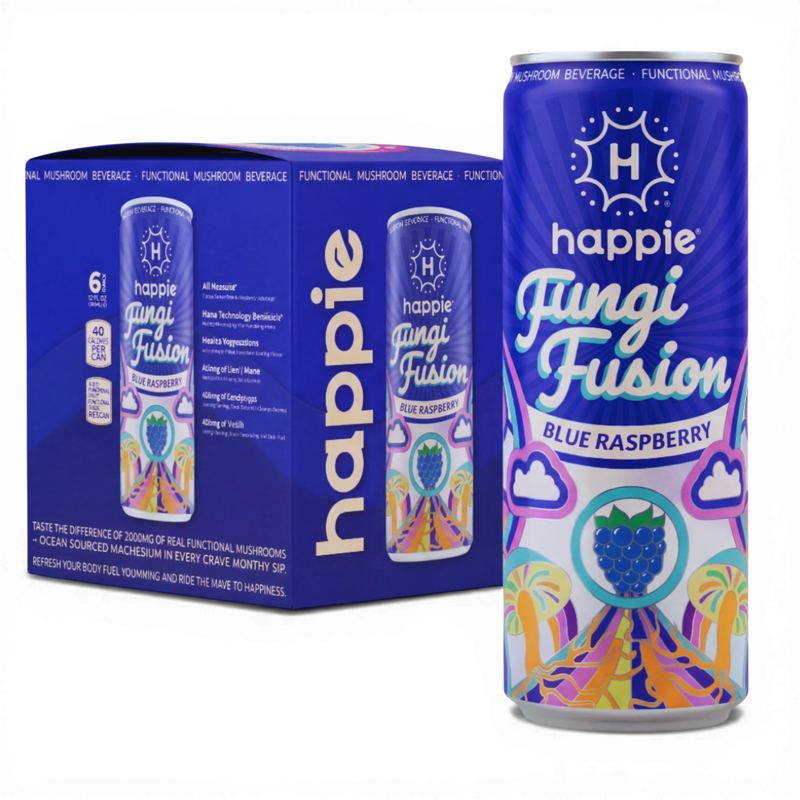
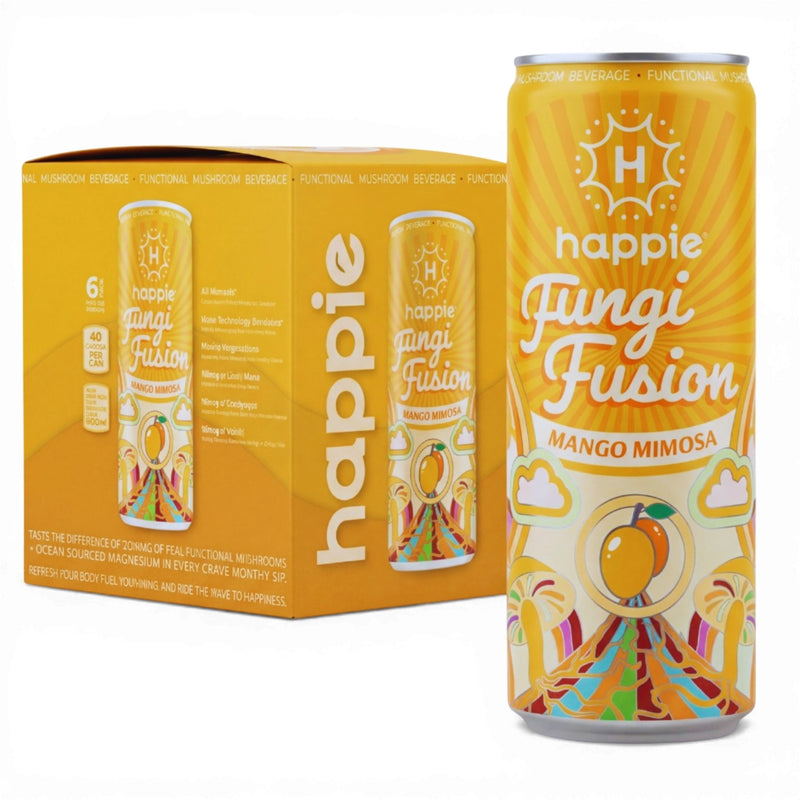
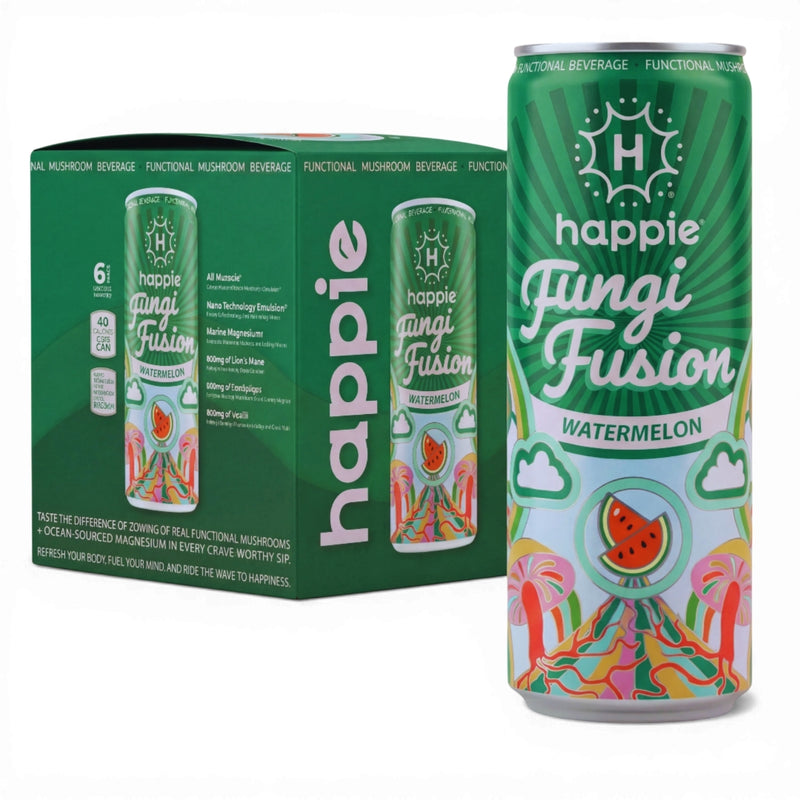
1. Happie Fungi Fusion — The Clinical-Dose Leader
Format: Sparkling RTD, 12oz can, caffeine-free
Mushroom load per can: 900mg Lion's Mane, 700mg Cordyceps, 400mg Reishi (dual-extracted)
Bonus actives: 230mg marine magnesium + 90mg marine calcium (Aquamin)
Calories / sugar: 40 cal / 9g
Retail: $23.99 per 6-pack
We'll get the disclosure out of the way: this is our brand. We built Fungi Fusion specifically because nothing else in the RTD aisle hit the doses the research uses. A 900mg Lion's Mane pour lands inside the same range used in the Mori et al. 2009 cognitive trial that put Lion's Mane on the map (1,000mg/day, three times daily). The 700mg Cordyceps load matches the dosing range used in athletic performance studies. The 400mg Reishi is paired with the other two for the classic "focus, energy, calm" triple stack rather than as a standalone sleep aid.
We dual-extracted everything — fermentation, hot water, and a 90-day alcohol extraction — because that's what unlocks both the water-soluble beta-glucans and the alcohol-soluble triterpenes. Most RTDs pick one method or use cheaper mycelium-on-grain material. The added marine minerals (Aquamin from Icelandic seaweed) are a hydration kicker we didn't see anywhere else in the category.
Trade-off: we sweeten with organic agave at 9g of sugar per can, which is heavier than zero-sugar competitors. We made that call deliberately — the natural bitterness of dual-extracted fruiting bodies needs more than a packet of stevia to be drinkable, and we'd rather lose the zero-sugar shoppers than ship something that tastes like wet bark.
Verdict: The dose-per-can leader in the RTD category. If the only thing you care about is whether the drink will actually do anything, this is the answer. Flavors: Mango Mimosa, Watermelon, Blue Raspberry, with Blackberry Lemon launching this spring.
2. BRĒZ Flow — Best Single-Mushroom Lion's Mane
Format: RTD can, caffeine-free
Mushroom load per can: ~2,200mg fruiting-body Lion's Mane (single mushroom, per the brand's published specs)
Caffeine: None
Retail: ~$5–$7 per can depending on variant; 20% subscription discount
BRĒZ built its name on hemp-derived THC social tonics, but Flow — launched in early July 2026 — is its most serious swing at the pure functional shelf, and it deserves to be taken seriously. The headline number is real: roughly 2,200mg of fruiting-body Lion's Mane is the largest single-mushroom dose we've seen in any RTD, and it clears the Mori et al. threshold on its own. Credit where it's due — that is not a marketing dose.
Trade-off: Flow is a one-mushroom product. You get an enormous Lion's Mane pour and nothing else — no Cordyceps for physical energy, no Reishi as a calming counterweight. It's a scalpel, not a stack. It also sits inside a brand whose center of gravity is THC, which means the functional line is a side street rather than the main road.
Verdict: If you want the biggest Lion's Mane dose money can buy in a can and you don't need the other two mushrooms, Flow is the strongest option on the shelf — including against us. If you want focus, energy, and calm across a full day from a single can, a three-mushroom stack still does more.
3. Odyssey Elixir — Best Caffeinated RTD
Format: Sparkling RTD, 12oz can, caffeinated
Mushroom load per can: 750mg Lion's Mane + 250mg Cordyceps (per published label)
Caffeine: ~85mg per can
Calories / sugar: ~10 cal / 0g
Retail: ~$3.50 per can
Odyssey is the closest direct competitor to Fungi Fusion in format and intent — sparkling, RTD, mushroom-forward. The 750mg Lion's Mane disclosure is a meaningful number, and the brand has been transparent enough about extraction (dual-extracted) that we'll take them at their word. They lean caffeinated, which is a strategic split from us: one drink is positioned as your morning energy lift, ours is positioned as the all-day functional alternative.
Trade-off: The caffeine bundle is a "yes, and" rather than a clean test of the mushrooms. If you feel sharper after Odyssey, was that the Lion's Mane or the 85mg of caffeine? Probably the caffeine. That's not a knock — it's a reasonable product decision, but it's worth naming.
Verdict: The strongest caffeinated mushroom RTD on the shelf. If you want the Lion's Mane and the morning push in one can, this is the cleanest pick.
4. MUD/WTR — Best Coffee Alternative
Format: Powdered, hot drink (not RTD)
Mushroom load per serving: ~750mg total mushroom blend (Lion's Mane, Reishi, Chaga, Cordyceps — proprietary breakdown)
Caffeine: ~35mg from organic black tea
Retail: ~$40 for 30 servings
MUD/WTR pioneered the "morning coffee replacement" lane and still owns it. The taste is divisive (cacao + chai + masala), the price-per-serving is high, and the proprietary blend means you don't know exactly how much Lion's Mane you're getting versus filler. But the brand built the category, the ritual works for a lot of people, and the lower caffeine load is genuinely useful for adults trying to step down from coffee without going cold-turkey.
Trade-off: It's a powder you have to prepare, and the proprietary blend hides per-mushroom dosing. For an RTD-first comparison, MUD/WTR is in a different format altogether.
Verdict: Best in class for the "I'm trying to quit coffee" use case. Not really comparable to a sparkling RTD — more like comparing a French press to a seltzer.
5. Four Sigmatic — Most Available, Lowest Doses
Format: Coffee, instant mixes, RTD elixirs (varies by SKU)
Mushroom load per serving: ~250mg Lion's Mane in flagship coffee blend (other SKUs vary widely)
Retail: ~$15-$25 per box, depending on SKU
Four Sigmatic deserves credit for normalizing functional mushrooms for an entire generation of consumers — they were doing this in 2014 when most people thought "Reishi" was a sushi roll. But their dosages have not kept pace with the science. A 250mg Lion's Mane serving is a quarter of what the Mori cognitive study used. You'd need to drink four cups to approach a clinical dose. They make this easier by selling stronger SKUs (1,500mg Lion's Mane shots, for example), but the flagship products that drive shelf placement are noticeably under-dosed.
Verdict: The most accessible brand on the list and a reasonable starter drink. But if you've been on Four Sigmatic for a while and not feeling much, that's the math, not your imagination.
6. Trip — Best Mushroom-Adjacent Wellness Drink
Format: Sparkling RTD, 8.4oz can
Mushroom load per can: Variable; Trip's mushroom-forward SKUs include adaptogenic blends with Lion's Mane and Reishi, but exact per-mushroom amounts aren't always disclosed
Other actives: L-theanine, ashwagandha, CBD on certain SKUs
Retail: ~$3-$4 per can
Trip is more "chill seltzer with adaptogens" than "mushroom drink" — the mushroom contribution is usually a smaller piece of a broader stack (CBD, ashwagandha, L-theanine). The taste game is exceptional and the brand identity is the cleanest in functional beverage, full stop. But if you're specifically optimizing for mushroom dosage, Trip is not the place to look.
Verdict: Excellent product, miscategorized as a mushroom drink. Buy it for the L-theanine + CBD calm, not the Lion's Mane.
7. Recess Mood — Best for Light Functional Use
Format: Sparkling RTD
Mushroom load per can: Minimal — Recess Mood is built around L-theanine, magnesium, and ashwagandha, with mushroom presence on select SKUs only
Retail: ~$3 per can
We're including Recess for completeness because consumers conflate the category. Recess earned its spot in the functional aisle, but it's an adaptogen seltzer rather than a true mushroom drink. The Mood line is excellent for what it is — a relaxation product with strong taste and design. Just don't expect the Lion's Mane payload.
Verdict: A great seltzer, not a mushroom drink.
Mushroom Drinks vs. Mushroom Coffee: Which Format Wins?
The category divides cleanly into two formats — sparkling RTDs and powdered coffee alternatives — and they solve different problems. Here's the head-to-head.
| Attribute | Sparkling RTD (Happie, Odyssey, Trip) | Mushroom Coffee (MUD/WTR, Four Sigmatic) |
|---|---|---|
| Convenience | High — open and drink | Medium — requires prep |
| Caffeine flexibility | Caffeine-free options available | Almost always contains caffeine |
| Per-serving cost | $3-$4 | $1-$2 |
| Typical dose | 500mg–1,500mg+ per can (top tier) | 250mg–750mg per serving |
| Use case | Daytime, social, alcohol replacement | Morning ritual, coffee step-down |
| Drinkability | Excellent (sparkling, sweet, cold) | Acquired taste |
Verdict: RTDs win on convenience, social use, and (in the top tier) on dose. Coffee alternatives win on cost and on the morning routine. The smartest mushroom-first buyer probably uses both formats — coffee replacement at home, RTDs everywhere else.
The Dosage Problem Almost Nobody Talks About
Here's the uncomfortable truth about most mushroom drinks: the per-serving dose isn't even close to what the research uses, and the industry is hiding behind the word "functional" to obscure that fact.
When we were developing Fungi Fusion, we tested seven different extraction methods before landing on the dual-extraction protocol we use today. The reason we kept iterating wasn't taste — it was potency. A weak extraction at 1,000mg of raw mushroom delivers a fraction of the active beta-glucans of a strong dual-extraction at 500mg. So when you're reading a can, you actually need three pieces of information to know if the drink will do anything:
- The exact mushroom amounts (not "proprietary blend")
- The extraction method (dual-extracted is the gold standard for fruiting body material)
- Whether it's fruiting body or mycelium-on-grain (fruiting body is more potent; mycelium-on-grain is cheaper)
Most labels in the RTD aisle disclose item 1 and bury items 2 and 3. The brands worth your money disclose all three. After running Happie for six years and walking the floor at every major beverage trade show, the consistent pattern I see is that the brands cutting corners on extraction are also the brands cutting corners on transparency. The two failures travel together.
What the Research Actually Says
The published evidence on functional mushrooms is genuinely interesting — and also more limited than most marketing copy implies. Here's the honest summary of where the science stands in 2026, with the studies most relevant to RTD dosing.
Lion's Mane. The most-cited cognitive study is Mori et al. (2009), a Japanese trial that gave 1,000mg of Lion's Mane extract three times daily (3,000mg total) to older adults with mild cognitive impairment for 16 weeks. The treatment group showed measurable cognitive score improvements that disappeared after washout. Smaller trials since have used doses from 500mg to 3,000mg per day. The active mechanism is thought to involve nerve growth factor (NGF) stimulation, but the direct human evidence is still thin. Practical takeaway: any RTD delivering 500mg+ per can is in the ballpark; below that, it's a leap of faith.
Cordyceps. The athletic performance literature is the strongest body of evidence. Hirsch et al. (2017) found that 1,200mg of Cordyceps militaris over three weeks improved high-intensity exercise tolerance in trained subjects. Other trials at 600mg–3,000mg/day have shown similar effects on VO2 max and time-to-exhaustion. The 700mg in a Fungi Fusion can sits at the lower end of the trialed range — meaningful with daily use, modest with occasional sipping.
Reishi. The literature here is the most diffuse. Some support for immune modulation, some for fatigue reduction, some for sleep quality. Doses in trials range from 250mg to 1,800mg/day depending on the endpoint. We include 400mg in Fungi Fusion as part of the calming counterweight to Lion's Mane and Cordyceps, not as a primary functional driver.
Important honesty marker: none of this is medical claim territory. The research is suggestive, not conclusive, and individual response varies enormously. A drink isn't medicine. But the gap between "real research at real doses" and "wellness shimmer at sub-therapeutic doses" is what separates the top tier from the rest.
Frequently Asked Questions
How much Lion's Mane should you actually drink per day?
Most clinical trials showing cognitive benefits use between 500mg and 3,000mg of Lion's Mane extract daily. A single can of Happie Fungi Fusion delivers 900mg of dual-extracted Lion's Mane — within the effective range used in published research. Drinks delivering under 250mg per serving are unlikely to produce a noticeable functional effect on their own.
Are mushroom drinks safe to drink every day?
Adaptogenic mushroom drinks made with food-grade fruiting body extracts are generally well-tolerated for daily use in healthy adults. Lion's Mane, Cordyceps, and Reishi all have long histories of traditional use and a strong food-safety track record. That said, anyone pregnant, nursing, on prescription medications, or with autoimmune conditions should check with a clinician before adding a daily mushroom regimen. This is a wellness category, not a medical one.
What's the difference between mushroom fruiting body and mycelium-on-grain?
Fruiting body is the actual mushroom — the part you'd recognize at a grocery store. Mycelium-on-grain is the root-like network of the mushroom grown on a grain substrate (usually oats), which means a meaningful percentage of what you're consuming is the grain itself rather than mushroom material. Fruiting body extracts have higher concentrations of the bioactive compounds (beta-glucans, hericenones, erinacines) that drive the functional effects. Premium mushroom drinks specify fruiting body sourcing.
Do mushroom drinks have caffeine?
It depends on the format. Sparkling RTDs are split — some are caffeine-free (Happie Fungi Fusion, Trip), and some are caffeinated (Odyssey Elixir). Mushroom coffee alternatives almost always contain caffeine, usually at a lower level than regular coffee. If you're avoiding caffeine, read the label — "functional mushroom" doesn't automatically mean caffeine-free.
Will mushroom drinks make me feel anything immediately?
Probably not on can one — and any product promising an immediate effect is overpromising. The best evidence for Lion's Mane and Reishi is on consistent daily use over 2-8 weeks. Cordyceps has somewhat more acute effects on exercise tolerance, especially with daily use over 1-3 weeks. Treat mushroom drinks like coffee for cognition: a daily routine, not a one-shot supplement.
Why are some mushroom drinks so much more expensive than others?
Three factors drive the price gap: the actual milligram dose of mushroom extract, the extraction method, and whether the source is fruiting body or mycelium-on-grain. A drink with 250mg of mycelium-on-grain costs the brand a fraction of what 900mg of dual-extracted fruiting body costs. The cheap ones aren't a deal — they're a different product wearing similar packaging.
The Bottom Line
The mushroom drink category in 2026 is real, growing, and crowded — but most of what's on the shelf is dosing for marketing rather than for function. If you only remember three things from this article: insist on disclosed per-mushroom amounts, prefer dual-extracted fruiting body sourcing, and benchmark per-can doses against the 500mg+ Lion's Mane / 600mg+ Cordyceps thresholds the research actually uses. Anything below that, you're paying for a sticker.
We built Happie Fungi Fusion to sit at the top of that ranking, and the doses on the can match what the studies use. If you want to sample the lineup, our Fungi Fusion variety pack gives you all three flavors — also available on Amazon. If you're new to functional mushrooms, start with the Mango Mimosa — it's the easiest entry point.
Where the category goes next: expect dosing transparency to become a competitive moat over the next 18 months, expect a wave of regulatory attention as the FDA takes a harder look at functional claims, and expect the proprietary-blend strategy to age very poorly with informed consumers. The brands that disclosed everything in 2026 are going to look prescient by 2028.
Drink the dose, not the marketing.
About the author: Pete Olander is the founder and CEO of Happie Beverages, makers of Happie Fungi Fusion and Happie Delta-9 THC sparkling drinks. Before Happie, Pete spent years in functional nutrition product development at Nutrition53 and earned his analytical chops at J.P. Morgan. He's spent six years building Happie from a NorCal kitchen experiment into a national functional beverage brand.
Share:
Shop the Lineup
Pair what you just read with the drinks made for it.



-

The THC Drink Ban Has Two Deadlines Now, Not One
The hemp THC deadline moved to December 11 — but one class of product still loses legal status November 12. Which date applies to what, from a founder inside it. -

Mushroom Drinks Instead of Alcohol: The Sober-Curious Swap That Actually Sticks
Swapping alcohol for mushroom drinks? Here's how functional mushroom drinks work as an alcohol alternative — the science, the ritual, and how to choose.
-

Fruiting Body vs Mycelium: The Mushroom Supplement Difference That Actually Matters
Fruiting body vs mycelium: the mushroom supplement difference that decides whether you are drinking real potency or the grain it was grown on.


